


U2’s new EP is well-traveled, hard-hitting and timely.
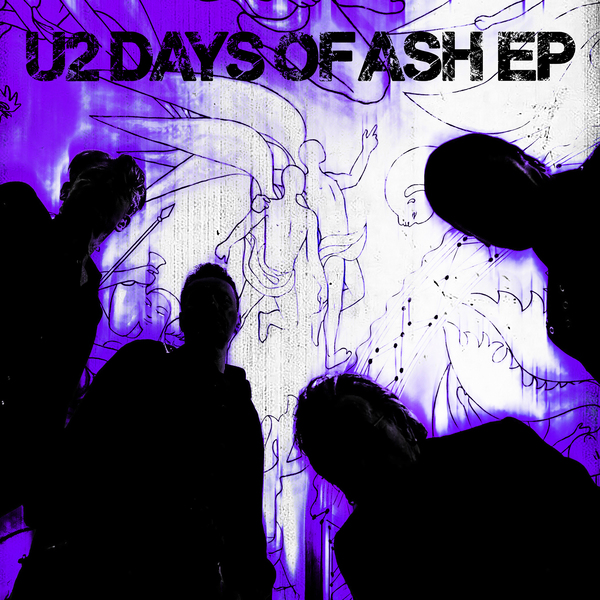
It’s not a good omen when we have to spend a decade without any new U2 music. The band’s Feb. 18 release “Days of Ash” marks their first EP or LP of new material since 2017, their longest drought since the band’s inception. The last time the world went nine years without a new U2 record, we saw conflict in Vietnam, the Watergate scandal, stagflation, the Soviet invasion of Afghanistan and the fall of the Pahlavi monarchy in Iran.
Now as then, Bono and company are faced with a world that needs a touch of hope, or at least good music. “Days of Ash” is proof that they understand the assignment. The album traverses many of the great tragedies of our time, travelling frenetically from modern Minneapolis to fascist Italy, from Iran to Gaza to Ukraine. Yet in reminding listeners of these tragedies, the band also seeks to come to terms with them, spreading hope and good music aplenty.
My first thought upon hearing the intro to opening track “American Obituary” was that Edge is finally back. The legendary guitarist takes center stage on this hard-rocking punk cut in a way reminiscent of peak U2. “Peak U2” may even be a fitting description of “American Obituary.” The anthemic repetition of lines such as “the power of the people is so much stronger/than the people in power” and “I love you more/than hate loves war” recalls the antiwar classic “Sunday Bloody Sunday” but locates itself in the streets of Minneapolis rather than Belfast.
“American Obituary” is a tribute to Renée Good, with Bono chanting out the time, date and place of her death like he did Martin Luther King’s on “Pride.” Good was shot and killed by Immigration and Customs Enforcement agent Jonathan Ross on Jan. 7th of this year. The end of the song’s music video shows a silent, written commemoration of Good; every song on the EP contains a similar tribute. War, America, heroism — these are foundational U2 subjects, covered here with all of the gravitas and earnestness of the band at their best.
Despite the mournful subject matter, “American Obituary” is defiant and raucous, proclaiming that “America will rise” and fight back the forces of tyranny once more. It’s a welcome rallying cry, worthy of the woman that inspired it. “Days of Ash” starts by taking the band back to their hard-rocking roots and reminding the world that it needs some U2 in it.
U2 has been vocal about how their new album is impacted by current national and global affairs. Photo courtesy of @u2 on Instagram.
After releasing pent-up energy on “American Obituary,” U2 slows things down on their second track, “The Tears of Things.” For the only song on its EP that doesn’t take place at the center of an active conflict, Bono pens a picture of Michaelangelo’s David — given a tribute at the end of the song — as a melancholy statue silently observing world history from his perch in Florence, Italy’s Galleria dell’Accademia. In this story, David is paid a visit from two leaders of the axis of evil: Benito Mussolini and Adolf Hitler. He muses on the six million lost in the Holocaust and longs to cry, begging God to preserve our shared humanity and bring freedom to every corner of the world.
The song’s warning is unspoken yet clarion clear: never forget, never turn away, never abandon a people to their death. The guitar from Edge and Adam Clayton is excellent, making space for Bono’s haunting vocals while punctuating the song’s plaintiveness. Wedged almost as an interlude between two more upbeat songs tackling the conflicts of our generation, “The Tears of Things” still doesn’t feel out of place.
If the subject matter of “American Obituary” is an odd choice for a track focused on hope and defiance, “Song Of The Future” seems even more so. Its muse, Sarina Esmailzadeh, was killed on Sept. 23, 2022 by Iranian security forces, protesting the Islamic Republic regime that has now weathered over 45 tumultuous years in power. Esmailzadeh had been inspired to protest by the regime’s killing of Jina Mahsa Amini, who shares a tribute with Esmailzadeh at the song’s end. Hope has been crushed in Iran time and time again.
Yet protesters continue pouring into the streets even now, killed by the hundreds, and Edge’s jangly licks punctuate Bono’s proclamation that Esmailzadeh’s song is the titular “Song Of The Future.” In U2’s telling, no matter how long it takes, liberty will win in the end. Women are the future, and women’s liberation will be Iran’s. It’s a good thing that the message is so moving or else it would be annoying having the earworm chorus of “Sarina, Sarina, she’s the song of the future” on repeat in my head. With “Song Of The Future,” the band have made both a radio-ready pop hit and the perfect song for the moment.
After an interlude featuring Israeli poet Yehuda Amichai’s pro-peace poem “Wildpeace,” U2 offers a tribute to the late Palestinian activist Adwah Hathaleen. Hathaleen was killed on July 28, 2025 in the West Bank by Israeli settler Yinon Levi, and the band commemorates him on “One Life At A Time.” The song asks the question of what can be done to fight tragedies such as the Israeli invasion of Gaza or organized settler colonialism of the West Bank. The answer is contained in its title: the solution is found one life at a time.
Bassist Adam Clayton and drummer Larry Mullen build a haunting setting as Bono croons, his voice just one in a sea of sound. “One Life At A Time” makes a compelling argument that Hathaleen did not live in vain, that any injustice could be stopped if the world took inspiration from him, if each of us asked ourselves what we could do to help. We can’t trust the government to do things for us in this brave new world, hence the closing line “if there’s no law/Is there no crime?”
ICE, the Iranian morality police, Israeli settlers, the Russian Army — all of these are aided and abetted by their respective governments. Yet we may get justice for crimes even in the absence of laws, when we fight back one life at a time.
The final track on “Days of Ash” opens with the voice of Taras Topolia, the lead singer of Ukrainian band “Antytila.” The premise of “Yours Eternally” is that it is a letter sent home by a soldier fighting on the Ukrainian front. After Topolia’s intro, Bono sings the contents of the supposed letter, then Ed Sheeran gives an imaginary response from the soldier’s family.
All three vocal performances are impressive, though Sheeran steals the show. The song’s tribute is given to Topolia, whose Free-UA foundation supports Ukrainian soldiers and civilians and who is himself a veteran of the Russo-Ukrainian war. At the end of “Yours Eternally,” Topolia chants “Volia, Volia,” which means both “freedom” and “willpower.”
Though ostensibly a letter to a loved one that the author may never see again, the song also serves as an expression of the Ukrainian fighting spirit, the willingness to do whatever it takes to secure freedom. It’s a fitting note to end on for an album that honors several heroes who sacrificed their lives to make the world a better place. “Days of Ash” is U2 once again at their best, meeting their world-weary listeners with joyous, relevant music and an exhortation to hope, because hope can change the world.