The amount of hidden gems in Tulsa may be surprising to some, but there’s plenty to go around.
Tulsa is not very well known for its architectural sights compared to other cities in the United States. NYC has vintage skyscrapers that pierce the sky across all five boroughs, and Chicago and L.A. are both filled with iconic buildings that make up their skylines. Even the relatively nearby St. Louis has its famous arch that attracts tourists from all over the world. Comparing Tulsa to these urban giants may leave some to discount many of the gorgeous buildings this city has to offer, but that would be a mistake in my opinion, and the proof can be found less than 10 minutes from campus.
5. The Philcade
Completed in 1931, the Philcade building was designed for, as well as named after, oilman Waite Phillips. The building was designed to complement the Philtower across the street, and leaned more toward the Art Deco influences that partially inspired said tower. The exterior is covered in layers of light and dark terracotta that frame the building, with designs of vines and animals being chiseled into the lighter rock above the second floor. Despite the beauty of the exterior, it’s the interior lobby that really steals the show. Bathed in a golden glow, the lobby of the Philcade is just absolutely stunning: stained glass windows, marble floors and walls, detailed chandeliers and geometric designs laden across the ceiling. Combined, the internal and external facets of the Philcade make it one of Tulsa’s best sights to see.
4. Tulsa Union Depot
Formerly the central railway station for Tulsa, the Tulsa Union Depot now stands as a monument to an era of industrious development that took place in the city during its construction and usage. Similar to the Philcade, it was completed in 1931 and saw use up until its abandonment in 1967. New developments that were occurring with cheaper automobiles and highways that now spanned the entire country meant that passenger travel by train slowly became obsolete. The depot is done in a similar Art Deco style to other buildings of the era. However, it relies more on flatter, heavier designs than the ornamental designs of other similar projects. This particular style gives the Tulsa Union Depot a unique feeling that reaches simultaneously towards the ancient past and the far-off future. Although temporarily closed for renovations, we will hopefully see this wonderful piece of Tulsa history back open to the public sometime soon.
3. Boston Avenue United Methodist Church
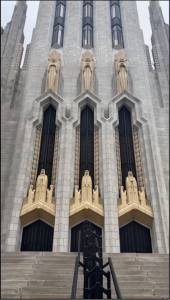
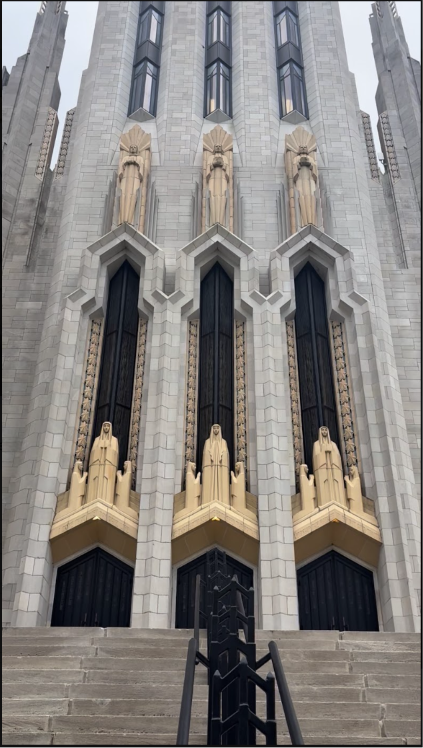
A fact that may be surprising to some is that Tulsa has a plethora of beautiful churches that are open to both regular religious services and guided tours. These include, but are certainly not limited to, the Trinity Episcopal Church, First Presbyterian Church and the Holy Family Cathedral. Despite each of these being worth a visit on their own, the Boston Avenue United Methodist Church stands out for its combination of Art Deco style, so popular in Tulsa, and religiously ecstatic imagery. The front doors of the church are overlooked by giant statues of praying figures, with the minimalist design of said statues contributing to the futuristic feel of the structure. If you get the chance to have a tour, you will be led down hallways covered with incredible mosaics of religious scenes and symbols and led to room after room that convey the serenity of the church, as well as the devotion of its parishioners. It is very rare to find a place that feels both sacred and avant-garde, which is why I feel the Boston Ave United Methodist Church deserves highlighting.
2. Center of the Universe
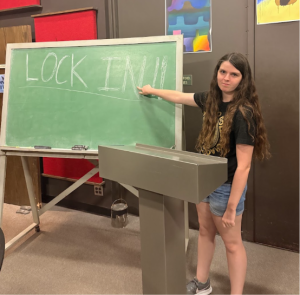
Not every landmark in Tulsa is necessarily a building. The Center of the Universe, located between Archer and 1st on Cincinnati Avenue, stands as a peculiar sight to those unfamiliar with the acoustic phenomenon. The small circle is surrounded by a ring of bricks, and hovering above is a metallic pillar topped with the silhouette of a cloud. When you stand inside the circle and speak, your voice will reverberate back much louder. This auditory phenomenon cannot be heard from outside the outlined circle, and there is yet to be a clear consensus on what exactly causes the sound from inside to be distorted. Whatever the cause may be, it is a strange thing to experience, and being so close to other landmarks on this list makes it easy to visit alongside them.
1. Philbrook Museum
The Philbrook Museum of Art completes this list as something relatively unique. Unlike the grand Art Deco structures mentioned previously, the feeling of the Philbrook is much more ornate, at times even seeming like an old European villa in the middle of Tulsa. The building is named after Waite Phillips, the same man behind the Philcade and Philtower, and served as his residence until he donated the property to the city in 1938. The lavish home of the famous philanthropist and oilman has been an incredible museum of ancient and modern art since then. There is just too much to talk about when it comes to the Philbrook; each room offers something completely different when it comes to place of origin, era of art history and style of artistic expression. This is not even mentioning the exterior designs and gardens that have become very popular for wedding photo shoots. Fortunately for university students, admission is free if you bring your ID. It’s a great afternoon spent if you get the chance to.
None of these structures were originally made to attract or impress people from outside of Tulsa. They were built from the oil money that flowed from this region during the early 20th century, and mostly provided for the people of said industry during their time. Today, they now serve as the major landmarks of not just this city, but of Oklahoma more broadly. Open to the public and sometimes even free for students, most of these are easy to access and within a 10 minute walk from each other. I recommend that you check out at least one while you are here.