


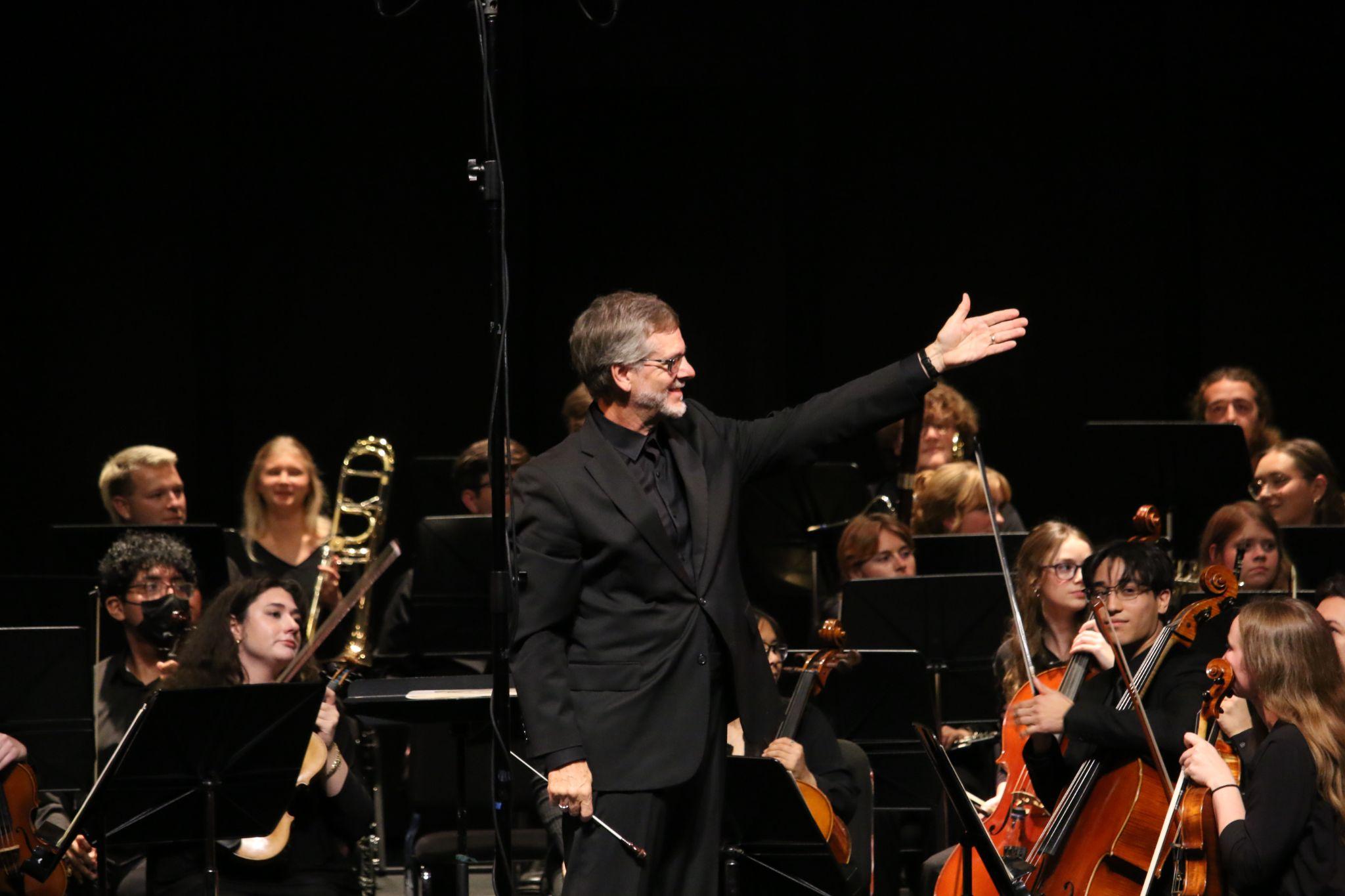
The University of Tulsa’s Symphony Orchestra plays to the soul at their first concert of the 2026-27 year.
Last Monday, Oct. 26, the University of Tulsa’s own symphony orchestra performed their very first concert of the 2026-27 school year, titled “Tales from the North.” The orchestra was conducted by Richard Wagner, associate professor and music and instrumental ensembles director in his 21st year at TU. A collection of three songs were played at the concert.
The concert opened with “March” from “The Tale of Tsar Saltan” Suite, Op. 57 by Nicolai Rimsky-Korasov, an opera based on Alexander Pushkin’s fairy-tale poem. This piece is the first movement of the opera, also called “The Tsar’s Farewell and Departure,” and tells the story of Tsar Saltan leaving his kingdom and the expecting queen to go to war. Soon after he leaves, the Tsaritsa gives birth to their son. However, she continues to wait for a reply from the Tsar after delivering the news, but there is no response. The program notes describe this piece as capturing “the opera’s most evocative scenes through brilliant orchestral color and vivid storytelling.”
The “Lieutenant Kijé” Suite by Sergei Prokofiev was also performed in all five movements. This piece is a story about a lieutenant that was conjured out of thin air due to an error by an office clerk while copying official military documents. Out of fear of angering Tsar Paul by admitting the mistake, government officials invent an entire career for the esteemed Lieutenant Kijé, leading to his promotion, wedding, exile, imperial pardon and mock funeral. The piece consists of five movements that each detail a stage of his fictional life. A solitary, beautiful trumpet motif opens a majority of these movements, followed by military fanfare, romantic strings or heavy percussion. The longest piece by far, the “Lieutenant Kijé” Suite was so moving that it almost triggered an early standing ovation.
Finally, the orchestra closed with “Four Norwegian Dances,” Op. 35 by Edvard Grieg in all four movements. Before receiving widespread orchestral fame, the program says that Grieg wrote the Norwegian dances “for the intimate setting of the 19th-century parlor.” Grieg took heavy inspiration from folk tunes by folklorist Ludvig Mathias Linderman. Each movement mixed gentle and slow tunes with an incredible wild energy, and it made for a wonderful closer to the orchestra concert.
Ethan Kirha, a biology major, is one of only 12 freshmen that performed in the concert last week. Kirha had been playing cello since the sixth grade, after his parents convinced him to join orchestra instead of P.E. Outside of his orchestra practice, Kirha spends around three to four hours a week practicing his cello, which he said he was “able to balance it out pretty well” with his other schoolwork. Kirha further stated that his favorite piece to perform was Grieg’s “Four Norwegian Dances,” but his favorite movement was “The Birth of Kijé,” the first movement of Prokofiev’s “Lieutenant Kijé” Suite, praising the woodwinds and brass on their performance of this movement.
When asked about his conductor Richard Wagner, Kirha said he made the rehearsals very fun. “I think he was [an] amazing conductor … he knows how to balance … his seriousness and his playful side. … He really understands … what he needs to get the best out of this orchestra.”
The University of Tulsa’s Symphony Orchestra’s first concert of the school ended up being an absolutely magical sensation. With the huge turnout, powerful pieces and phenomenal performances, they have set the bar high for the following concerts. Be sure to check the TU Events Calendar for information about the School of Music’s performances.