
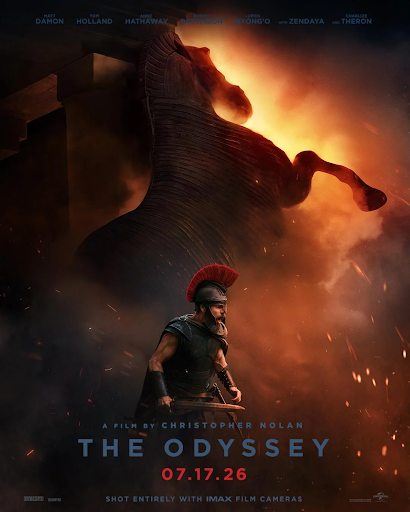
Christopher Nolan hits the box office with his visually stunning take on the Homer classic.
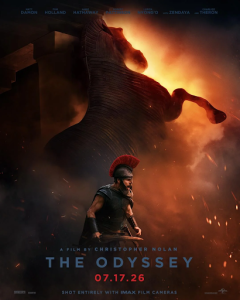
One of this summer’s hottest blockbusters was Christopher Nolan’s The Odyssey, a classic almost as old as writing itself. Much to the chagrin of many history buffs and terminally online movie critics, Nolan attempts neither to make the movie particularly “historically accurate” nor adhere all that closely to the original themes in The Odyssey. However, by doing so, Nolan tells the story in one of the most ancient Greek ways possible — taking an already-existing, well-established story with its characters and events and then changing them narratively to create an almost entirely new work. Nolan uses the narrative framework of The Odyssey to tell a tale of a much more grounded and real Odysseus, troubled by the atrocities he committed during the Trojan War, which were “forced” on him by the titanic and foreboding Agamemnon. This Odysseus is accompanied by a Penelope spiritually united with her husband but physically apart, and a young, hot-headed Telemachus who often has to be reigned in by his mother. Despite the movie being labeled as “woke” for some of its casting choices, the only strong political messages were the timeless truths that senseless war leads to unnecessary ruin, and that the rampant destruction of tradition leads to the breakdown of societal structures. Even if I did not find Nolan’s take on The Odyssey refreshing, the visuals alone would have been enough to keep me in my seat for the whole movie.
Although I did not see the movie in IMAX, I was still held captive the entire time by the cinematography. There are many awesome visuals throughout the movie, but this is especially true of the scenes with magic and monsters in them. Circe’s transformation of Odysseus’s crew into pigs is particularly striking. The sheer grotesqueness of the transformation of the flesh was absolutely appalling and enthralling. Nolan’s portrayal of the monstrous figures of Polyphemus, the Laestrygonians and Scylla and Chadybris were also very well done. Anytime any of these figures were on screen, I felt a palpable fear for the characters they shared the screen with. Every moment in the film felt real and concrete instead of fantastical and far-strung, in massive part due to how well the visuals were produced. Even the more “realistic” scenes were impressive. While there are far flashier fights out there, both the sack of Troy and the killing of the suitors were well-choreographed and felt real enough to not be jarring. However, as good as Nolan’s visual spectacle is, the movie would have been far worse without its excellent cast.
The actors in this movie all did an exceptional job in making it feel grounded and real. Tying back to complaints over “historical accuracy,” there has been an uproar from online populations about the refusal to cast Greek actors, or the casting of certain individuals like Elliot Page as Sinon or Lupita Nyong’o as Helen of Troy. Not once did a casting or actor even snap me out of the story Nolan was trying to tell, and most of them had particularly exceptional performances. Matt Damon does a wonderful job of portraying Nolan’s brooding Odysseus, and his acting really illuminates the tension Odysseus feels between his desire to return to Penelope and his desire to right his wrongs. Anne Hathaway’s Penelope was also the star of just about every scene she was in. Nolan’s version of the character is far more concerned with love and being with her husband than she is in Homer’s, which adds a lot of depth to her screen appearances. The fear she feels at being overrun and forced into marriage is apparent in everything she does, and the way she handles herself and Telemachus is a perfect example of strong women in the box office. Tom Holland’s Telemachus is a role he has filled many times: that of a developing, fool-hardy teenager who still has lots to learn about the world. Nevertheless, his character’s arc still feels fun and exciting. One of the most outstanding performances was Robert Pattinson’s Antinous, the primary suitor of Penelope and rich scumbag extraordinaire. Pattinson did an absolutely excellent job of delivering on the unsavory parts of the character. The force with which he disdains anyone below him is absolutely captivating — just look at the line “Somebody get these beggars out of here” and how it took the internet by storm for proof. As one last note on the cast, when I found out Travis Scott was in the movie I figured it was just a throw-away role that would neither add nor detract much of anything from the movie. While his role as the bard was not essential to the movie by any means, it was definitely better for him being there. His energy provided a kind of bold solemnity that added a lot of gravity to the scenes he was in, and I greatly enjoyed his performance.
All-in-all, I was very impressed with The Odyssey. Even though the plot itself is not particularly novel, Nolan managed to change around the classic story enough to give it a new freshness. In tandem with an excellent cast and beautiful cinematography, Nolan uses this new take to lure audiences in and tell the story he wants to tell. While it definitely is not my favorite Nolan film ever, I still relished the almost three hours I was in the theater, and probably would have sat through another hour more of the epic ballad.