


How student journalism broke through institutional silence to demand accountability.
A 101-page lawsuit was filed in mid-September by a former Cornell University student alleging a seven-hour gang rape by seven men inside the Chi Phi fraternity house in October 2024. The effects of the alleged assault have reverberated far beyond the campus in Ithaca, New York. For 23 months, the incident was obscured from public view, with zero criminal charges and only an internal university Title IX review, leaving much of the student body unaware of the allegations. However, the revelation of this lawsuit fundamentally disrupted that silence. Faced with immediate public backlash and scrutiny, Tompkins County District Attorney Matthew Van Houten announced Monday that his office would reopen the case and present evidence to a criminal grand jury. This sudden shift from institutional inaction to legal scrutiny highlights a critical reality in higher education: when institutions fail to provide transparency, independent student journalism can bring those failures to light.
The lawsuit has brought renewed attention to what happened after the alleged assault was reported to the university. While the criminal investigation remained inactive for nearly two years, the university conducted its own Title IX process and imposed disciplinary measures on the students involved. Those measures have since become a central point of dispute, with the plaintiff’s legal team, university administrators and defense attorneys offering sharply different accounts of how the case was handled.
The unfolding legal battle reflects a stark divide between administrative procedures and public expectations for safety. According to the plaintiff’s legal counsel, Thomas Giuffra, the internal university discipline was drastically insufficient. Giuffra states that, while two of the defendants were expelled from the university, the other five were permitted to address their actions through lesser sanctions, such as workshops and essay-writing assignments. Conversely, Cornell University administration, represented by Vice President for University Relations Kyle Kimball, rejects this characterization. “None of the individuals charged were offered the opportunity to write essays as a sole consequence of their involvement,” stated Kimball on Monday, Sept. 28. Furthermore, defense attorneys representing the seven named students maintain their clients’ absolute innocence, arguing that the allegations are factually unsupportable. This public cross-examination of facts highlights a deeper structural crisis. When campus Title IX mechanisms operate entirely behind closed doors, they risk fostering systemic distrust among the very students they are mandated to protect.
The gap between what occurred behind closed doors and what the public knew about the case emphasizes the importance of independent reporting. Without sustained scrutiny from outside the university’s formal processes, the details of the case may have remained unknown beyond those directly involved. In this case, that scrutiny came from an unlikely but essential source: the student journalists who continued investigating the incident long after the university’s internal process had concluded.
The national momentum behind this case did not build from an administrative press release, but rather because student journalists refused to let the matter be swept aside. The lawsuit gained widespread attention on Sept. 18, when The Cornell Daily Sun broke the story of the civil suit filed by the survivor, Jane Doe. The newspaper secured an exclusive interview with her, illuminating the university’s internal Title IX mismanagement. The breakthrough was the result of relentless, long-term investigative journalism; reporter Cereese Qusba spent 22 months tracking the October 2024 incident, refusing to stop pursuing the truth. When Editor-in-Chief Sophia Dasser assumed leadership in March 2026, the paper made a deliberate choice to keep the story alive rather than allow it to disappear from institutional memory. In a subsequent editorial on Sept. 21, the student newspaper made the bold move of publishing the names of the accused students, demanding an independent investigation into why men accused of such a grievous crime were permitted back on campus. That kind of reporting demonstrates the essential role a free student press can play in holding universities accountable. While national media outlets typically report on campus crises retroactively, student journalists live within the ecosystems on which they report. They are uniquely positioned to connect localized administrative failures to broader national conversations about safety, Greek life oversight and judicial transparency.
The significance of this reporting extends beyond Cornell itself. By bringing the allegations and questions surrounding the university’s response into public view, The Cornell Daily Sun gave students at other universities an opportunity to examine how their own institutions and organizations respond to allegations of sexual violence. What began as an investigation into one campus has consequently become part of a broader conversation about accountability, transparency and the culture surrounding Greek life.
That broader impact is already visible on campuses far away from Cornell, prompting fraternities and sororities to reflect on their own cultures and responsibilities. Across the nation, student organizations are using social media to demand institutional change and proactively police their own internal cultures. At the University of Tulsa, students have responded quickly to the growing conversation about Greek life accountability. This comes after the four-year suspension of Kappa Sigma’s Epsilon Mu chapter for severe hazing and dangerous alcohol consumption. Individual students have posted calls for accountability on their Instagram stories, often asking people to care consistently about the survivors of sexual assault — not just when others are watching. On Wednesday, Sept. 30, the Gamma Upsilon chapter of Pi Kappa Alpha (PIKE) at TU issued a public statement via Instagram addressing the Cornell case directly, serving as a local example of this broader response. In their statement, the chapter noted they felt compelled to speak out against the “heinous acts” at Cornell, writing that they “vehemently condemn sexual violence in all forms.”
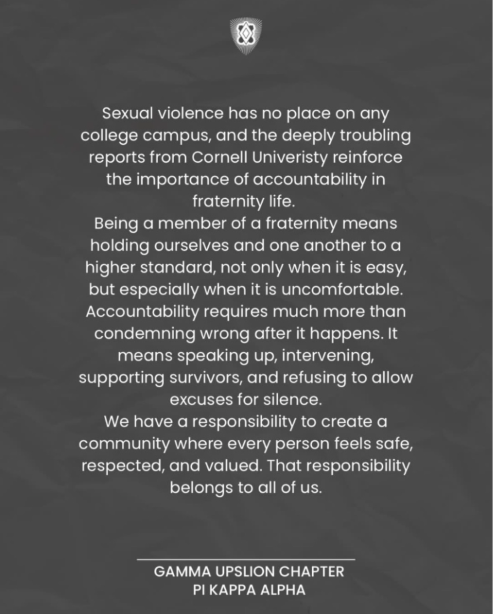
TU PIKE’s statement on Greek accountability. Stephen Lambert | Collegian
Crucially, this local mobilization reflects the call for responsibility championed by student reporters. TU PIKE’s statement explicitly rejects the standard excuses for Greek misconduct, noting that “social environments are no excuse to abandon human dignity and respect.” Rather than defending the institution of Greek life, the fraternity called for an end to the bystander culture that historically protects abusers. They urged the campus community to “look inward at our own behavior and the culture we foster within our organization,” and added that “we must have the courage to intervene when we see something wrong and hold our peers accountable.” This public stance by local students illustrates the ripple effect of investigative reporting. When student journalists have the bravery to expose institutional failures, they empower the student body to stand up, challenge systemic misconduct and begin the difficult work of cultural reform from within.
The response at TU shows how student journalism can do more than expose problems; it can also create the conditions for communities to confront them. When reporting publicizes an issue, students and organizations are given an opportunity to examine their own practices rather than waiting for administrators to act. In this way, the work of independent student journalists can extend beyond the original story, prompting conversations and actions that reach far beyond the campus where the reporting began.
The events at Cornell show why independent reporting is so important when institutions fail to act. When local authorities and university offices default to bureaucratic isolation, it falls upon student-led media to ask the uncomfortable questions, verify the facts and advocate for student safety. For independent student newsrooms across the United States, including The Collegian, this case serves as a profound reminder of the journalistic mandate. Student reporters do not just document campus events; they function as a vital check on administrative power. Supporting independent student journalism means giving students the tools to question institutions, expose failures and push their communities toward greater safety, integrity and accountability.