


When freedom of speech and freedom of religion become tightly intertwined, criticism can be dismissed as intolerance even when the statements in question may cause tangible harm.
Free speech on college campuses is often framed as a simple principle: everyone should be able to express their beliefs, even when those beliefs are controversial or unpopular. Universities describe themselves as marketplaces of ideas, places where disagreement and debate are essential parts of the educational experience. In practice, however, whose speech is protected and whose dignity is protected from the speech of others is far less clear. Recent events at the University of Tulsa highlight how unevenly the principle of free speech can be applied, particularly when queer students are the ones affected.
Last semester, during the university’s homecoming mural painting event, a mural created by members of Students for Justice in Palestine included the phrase “From the River to the Sea.” The mural was intended as a political statement protesting the devastating violence in Gaza and to draw attention to the humanitarian crisis facilitated by the Israeli occupation of Palestine. Students participating in the event were using a longstanding campus tradition, painting murals during homecoming, to express their views about a global conflict and the deaths of thousands of civilians. In other words, the mural was political speech: students used a public forum to call attention to a genocide. It was not a threat to campus safety.
Mere hours after the mural appeared, however, the university intervened. Administrators instructed students to alter or remove the phrase and convened a Threat Assessment Team to evaluate the situation. In a statement to The Collegian about the situation, administration emphasized that while it supports students’ rights to free expression, its “top priority is the safety and well-being of students.” Administration also stressed its commitment to fostering “mutual respect and empathy” within the campus community.
Those are all important values, but the response raises an important question: when does speech become concerning enough to require institutional intervention? Because when queer students are the ones targeted by speech, the university’s response is very different.
At the Spring Activities Fair, another university-sponsored event, an organization called The Faithful Observer distributed printed materials asserting that being LGBTQ+ is sinful and harmful. The pamphlet argued that queer people have been sold a false promise that identifying as LGBTQ+ would bring happiness or fulfillment. According to the text, “this is not true… and it has never been true.” The pamphlet claims that such identities are not good “for us or for our society.”
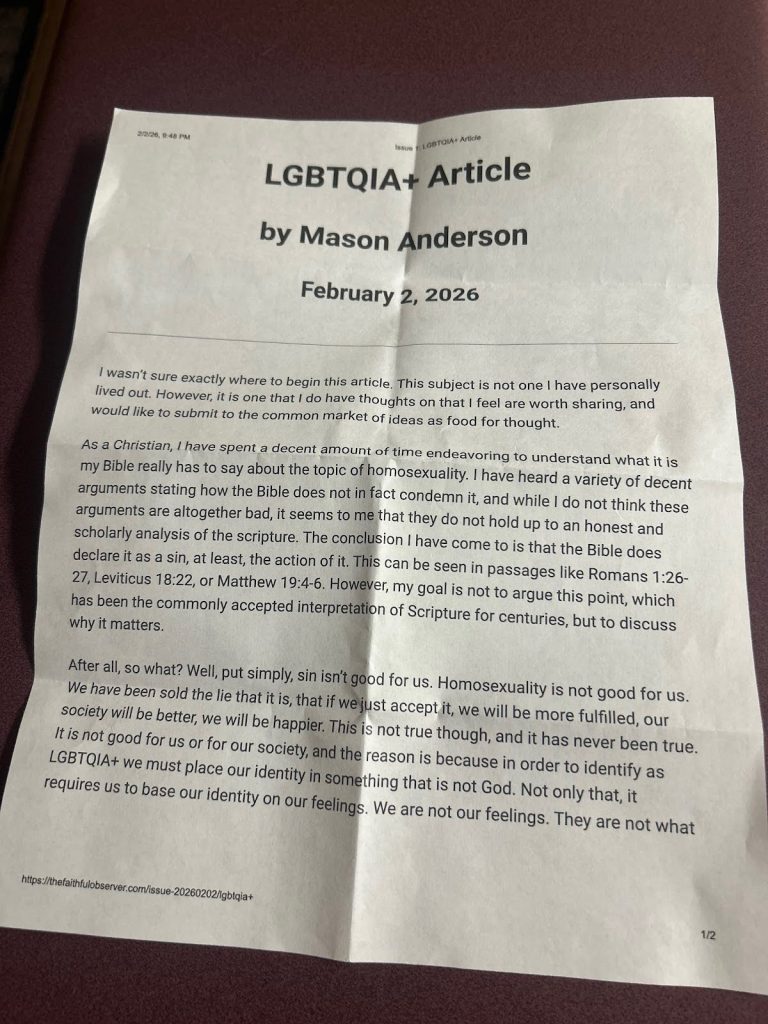
Materials distributed during the 2026 Spring Activities Fair by The Faithful Observer regarding their stance on the LGBTQIA+ community. Photo by The Collegian
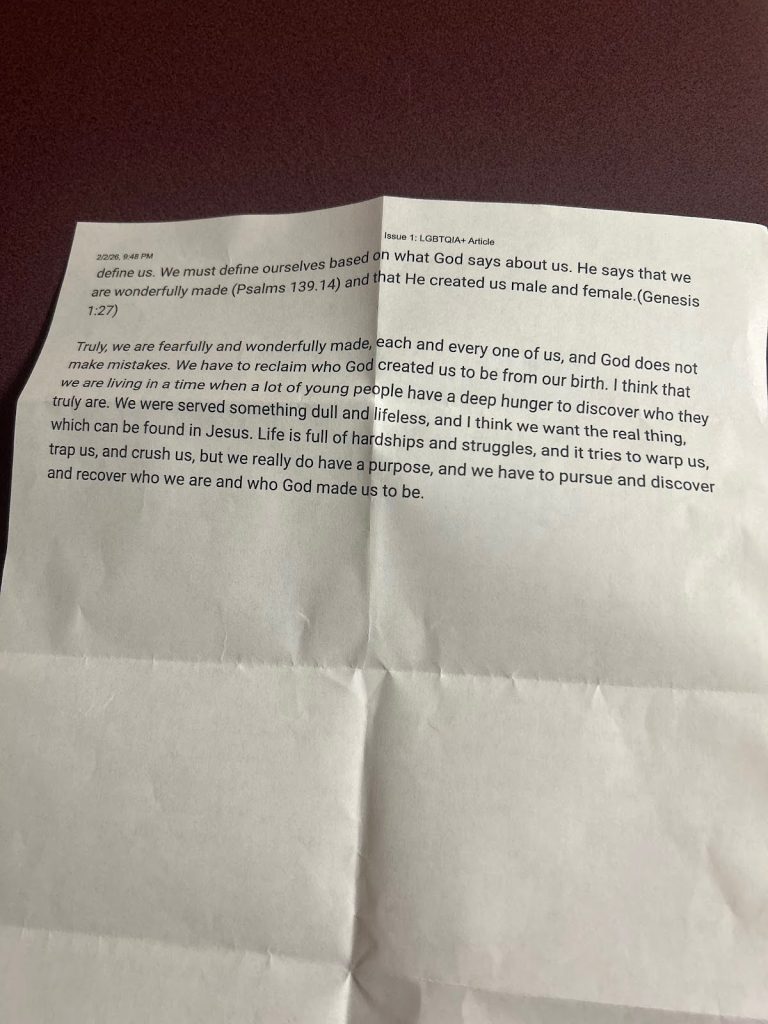
Materials distributed during the 2026 Spring Activities Fair by The Faithful Observer regarding their stance on the LGBTQIA+ community. Photo by The Collegian
For queer students walking past that table, this message was not just abstract theological discussion. It was a direct statement about them, saying that who they are is not only morally wrong but socially harmful. Yet no Threat Assessment Team was convened that night, nor did any emergency administrative response of any kind occur. The event continued without intervention, without statements about respect or empathy and without the same urgency displayed during the mural incident just months before.
This disparity is difficult to ignore. A mural protesting the violent deaths of thousands of Palestinians, political speech about a global humanitarian crisis, triggered immediate institutional concern in the name of campus safety. Printed materials describing LGBTQ+ sexualities as sinful and harmful to society did not.
Freedom of religion is deservedly a core value of our society, and religious students deserve the right to express their beliefs both on and off campus. That right does not exist in isolation from the broader campus community, however. When religious speech characterizes students’ identities as immoral or damaging to society, universities must also consider the environment they are curating for the people who have to coexist with such speech.
Too often, freedom of speech and freedom of religion become shields against criticism. Once speech is framed as religious conviction, it is frequently treated as untouchable, even when it undermines the dignity and belonging of other members of the community. For queer students specifically, this burden of tolerance often falls squarely on their shoulders.
This becomes even more relevant when considered in the broader political context surrounding LGBTQ+ people. Across Oklahoma and the country, queer communities face a growing wave of legislation targeting their rights and visibility. Lawmakers in Oklahoma recently advanced legislation that would prohibit state entities, including public schools, from recognizing Pride Month or displaying LGBTQ+ pride flags. The Oklahoma House has also approved restrictions preventing changes to the biological sex listed on birth certificates, while the state still lacks any statewide ban on conversion therapy.
Rhetoric claiming that LGBTQ+ identities are sinful or harmful does not exist in a vacuum. In fact, it echoes the same language used to justify policies that strip away recognition, protections and rights from queer communities. That is precisely why universities matter. Institutions like TU should be places where students can challenge ideas and debate controversial issues without being subjected to the same hostility that dominates American politics at large. As a private university, TU also has more flexibility to shape its environment than public institutions do, making the university’s choices about speech especially meaningful.
When administrators move quickly to intervene in one instance of controversial speech but remain silent in another, it sends a message about whose safety and dignity are prioritized. It also raises difficult but necessary questions. Does speech gain additional protection when it is framed as religious belief? Does invoking freedom of religion allow organizations to say whatever they wish about other students?
And perhaps most importantly: should it?
Would the reaction be the same if a non-Christian organization distributed materials declaring another religion sinful and harmful to society? If one faith publicly told another group of students that their beliefs made them morally corrupt or dangerous, would TU still consider it protected speech?
Universities must answer these questions, and in doing so, they reveal the power dynamics that shape what speech is tolerated and what speech is treated as a threat. Speech does not exist in a vacuum — it operates within cultural and political hierarchies that determine whose voices are seen as legitimate and whose are seen as disruptive. In the United States, Christianity has long held a position of cultural dominance, particularly in regions like the South and Midwest, where religious identity can be deeply embedded into public life. However, because of this dominance, speech coming from Christian organizations is often framed as a normal expression of belief, even when it condemns or stigmatizes another group.
Meanwhile, groups with less cultural power frequently face far greater scrutiny. When marginalized communities speak out, their speech is more likely to be labeled as inflammatory and unsafe, especially when it challenges dominant institutions. This dynamic seemingly explains why a mural protesting the occupation of Palestine, a majority-Muslim and Arab state, attracted administrative intervention hours after its creation, while The Faithful Observer’s pamphlet drew no response at all.
In all societies, the ideas of dominant groups are generally treated as normal and traditional while the ideas of marginalized people are seen as radical and disruptive. Queer students know that imbalance well thanks to this country’s social climate, which is generally hostile to them. The university’s response to speech on campus over the past year has, unfortunately, generally reinforced the national social hierarchy.
If the University of Tulsa truly hopes to foster the “mutual respect and empathy” it invokes in its own statements, it must examine how its approach to free speech functions in practice. When the rules appear to change depending on who is speaking, and who is being spoken about, free speech begins to look a lot less like a universal principle and more like a selective privilege.