

Pulitzer-Prize-winning New York Times journalist spoke to a packed audience at the Lorton Performance Center.
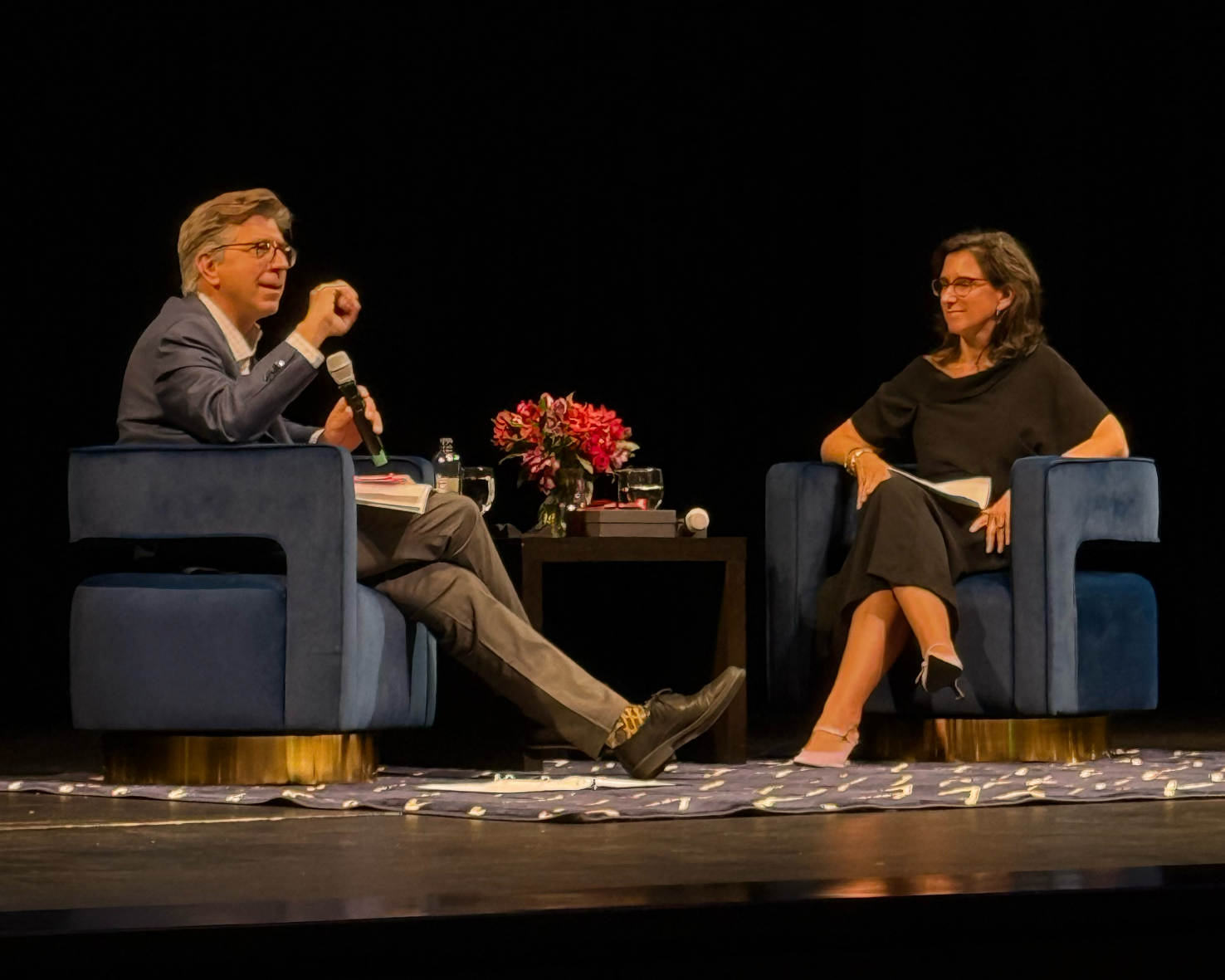
Last Thursday, Oct. 15, Pulitzer Prize-winning investigative journalist for The New York Times and best-selling author Jodi Kantor took the stage at the Lorton Performance Center. Kantor proceeded to deliver what Dr. Jan Wilson, professor of history and women’s and gender studies at the University of Tulsa, called an “enlightening” speech before subsequently sitting down with Dean Blaine Greteman to answer questions from him along with audience members.
For those who do not know, Kantor is most well known for her role in exposing decades of sexual abuse from one of Hollywood’s biggest names, Harvey Weinstein, alongside fellow investigative journalist Megan Twohey. The story, which began as an investigative article, eventually transformed into the bestselling book, “She Said: Breaking the Sexual Harassment Story That Helped Ignite a Movement.” Her work within this investigative piece earned her the Pulitzer Prize for Public Service in 2018 and was largely responsible for sparking the #MeToo movement.
She began her speech by briefly introducing investigative journalism, gracefully articulating that it is “the art of uncovering secrets … that are in the public interest to reveal.” Kantor then reflected on her experience investigating the Weinstein story, detailing how it started, various obstacles along the way, how it impacted her and Weinstein’s attempts to keep it from publication. First mentioning how it all started, she stated that her colleagues at The New York Times “published a story about Bill O’Reilly, the Fox News host, concealing allegations of sexual harassment.” Soon after the publication, O’Reilly was fired, marking what Kantor called “a change in the physics of how power worked.” This prompted editors at her magazine to ask a broader question: “Are there other powerful men in American life who have covered up the use of women, and can we find them?”
In response, Kantor recalled, “I made a couple of phone calls and I came back and said, I think we should look into Harvey Weinstein,” and emphasized that she “didn’t know the truth.” She used this uncertainty to highlight a key principle in investigative reporting, stating that it “is not activism, it’s more like science. … You go in with an open mind, not knowing what you’re gonna find.” In this case, Kantor recalled, “We weren’t pursuing Harvey Weinstein. We were pursuing one thing [the truth].” The emotional weight of the story stood out to audience members as TU senior Seraina Hatt, who attended the event, remarked that she was “struck by how composed Kantor remained after completing the Harvey Weinstein investigation.”
Drawing on her experience covering the story, Kantor expressed two lessons she learned. Firstly, she claimed that “a very small group of people can change the world. … A single individual who shares important information with a journalist can create change everywhere.” Secondly, she said, “The power of fact. … Progress for women, progress for anyone, depends on information, on solid fact, on lots and lots of people having a shared view of reality.”
Today, she remains an investigative journalist for The New York Times and centers her work around “revealing things about the United States Supreme Court.” The reason being that “the Supreme Court is reshaping American life, and yet it remains a locked box.” Thus, she noted that her job is to “try to open that locked box a little” and “establish an independent lens through which we can see the justices.”
Part of her time here was spent discussing her new book, “How to Start: Discovering Your Life’s Work,” which explores the question of “how, in this crazy time, are we supposed to find and discover our life’s work?” She described her book as a work “meant to provide encouragement and direction to young people at this time,” with the central message being “don’t give up before you start,” referencing her own career story on how she had a “horrible first impression of journalism,” got “kicked off the student newspaper at Columbia University” and “dropped out of law school.” However, through “embracing struggle,” she was able to carve out a successful career for herself.
Kantor is one of several notable figures to visit the University of Tulsa through the Presidential Lecture Series, which hosts speakers annually to discuss a wide range of topics. Past speakers have included current governor of Maryland Wes Moore and Academy and Emmy Award-winning filmmaker Molly O’Brien. The next speaker has yet to be announced by the university. Wilson stated that the series “can be a great opportunity to engage with people you do not usually come in contact within the community.”
Kantor’s visit to TU was a great opportunity for students, faculty and members of the local community to get an insight into one of the biggest investigative stories of the last decade and hear her thoughts on pressing issues relating to college students in today’s world. Many in the audience appreciated the chance to see her, as Hatt expressed that the experience was “fascinating” and a long line of attendees went to get their book signed following the event. The university will continue to bring notable speakers to the Lortan Performance Center, offering the community new perspectives on relevant issues.