



Dining center awarded Nobel Prize after splitting the atom to reduce portion sizes.
The Nobel Foundation recently announced that the Royal Swedish Academy of Sciences has chosen University of Tulsa food service employees as the winner of 2026 Nobel Prize in physics for their extraordinarily massive contribution to the study of the extraordinarily small. Unfortunately, campus administration has chosen to remain silent on this topic despite The Collegian’s repeated request to comment on the issue, so the details of how this occurred are currently unknown. If rumors are to be believed, however, the discovery might have occurred this summer during intensive experimentation happening in the Pat Case Dining Center. The university has been making many budget cuts, and it would seem they sought to reduce costs in Pat Case by cutting portion sizes, thus reducing food waste and overconsumption.
There have been inside leaks that the university was conducting all manner of unscrupulous experiments and tests to perfect the art of cheaping out on food. Allegedly, the workers had been innovating smaller and smaller portion sizes so that, as the year progressed, they could gradually shrink portions without students noticing anything. Even so, it would seem that, in the name of science and the pursuit of knowledge, the experiments were taken too far. Somehow, the investigation even went to the atomic level. Given the nature of how successful the experiment seems to have been, it appears doubtful that the university could have saved much money — experiments good enough to find a new way to split an atom surely cannot be cheap. Although the workers at Pat Case are wonderful and brilliant people, it is highly unlikely that they made such an amazing discovery on the university’s limited budget. This fact, along with the administration’s general unwillingness to be more transparent about the matter, has led many to question the veracity of the story the public has been told.
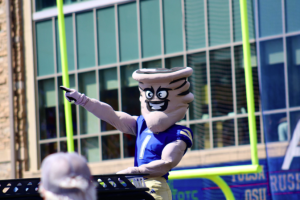
Many online conspiracy theorists — some of whom may or may not work for the State-Run Media — believe the whole story to be a cover-up for something much more nefarious. Some believe that the university was doing experiments to clone Goldie so that they never had to get another “new” Goldie ever again, but it seems unlikely that a breakthrough in physics would have happened during a biology experiment. A much more believable theory, at least according to those at the State-Run Media, is that the university was using secret AI technology to conduct alchemical experiments to turn materials into gold to help cut the university’s budget deficit. It is entirely possible that this AI tech was developed by Americans for Responsible Innovation and its president, former University President Brad Carson, which might have been very costly to produce, and could explain how the university got into so much debt to begin with. Of course, this is all rumor and hearsay, but it still makes more sense than the “real” story that has been provided to us.
Regardless, the breakthrough and the Nobel Prize being awarded for it do certainly exist. The monetary compensation associated with the prize is also just as real, but as of yet nobody knows what exactly the university plans to do with the $1,035,000. The State-Run Media surveyed many students to ask what they thought should be done with the money. There were two overwhelming responses: one, that students hoped that the industrious employees who made the field-changing discovery would see some of the money as a reward for their hard work, and two, that some of the money would go towards the food budget so the portion sizes could be just a little larger. Given how opaque the university has been so far about this situation, it seems unlikely that what happens with the money will ever be any clearer than what happened with the experiment in the first place. All students are left to do is hope that no one is planning to actually reduce Pat Case portions to a subatomic size.