

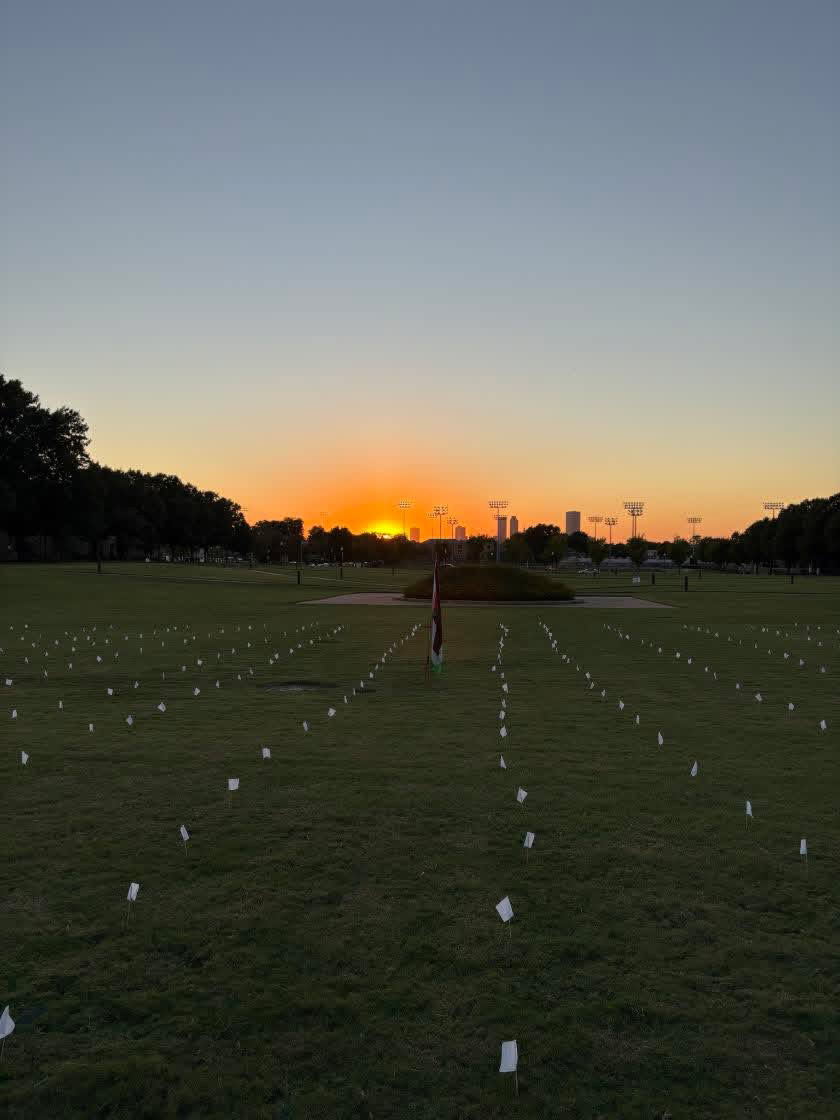
Several speakers offered remarks in remembrance of lives lost in Dietler Commons on Thursday.
At 5:30 p.m. on Thursday, Oct. 8, the Students for Justice in Palestine held a vigil at the end of Dietler Commons in front of McFarlin Library to mark three years of genocide in the Gaza Strip. The event was organized in coordination with Give Gaza Hope, the Muslim Student Association, the Arab Student Association and Red Equity TU. It took place in front of 750 small white flags, each representing 100 Palestinian lives lost, all alongside a large Palestinian flag.
After opening remarks were given by Sophia Rehman, fellow SJP member Luke Ternes, a sophomore biochemistry and political science major, spoke briefly about Gaza and the goals of the SJP. He began by pointing out the suppression of Palestinians in Gaza and the West Bank in the decades leading up to Oct. 7, 2023, following a century of displacement and settler violence. Ternes continued by critiquing U.S. support of Israel, including the ongoing investment in Israeli bonds, and contrasted this with the resilience of Palestinian people. He finished his remarks by demanding that the university release its own investments and divest from any companies that invest in or collaborate with Israel and the Israeli Defence Forces.
Following this, Dr. Nida’a Abu Jbara began her own speech. As a child of survivors of the Nakba — the 1948 displacement of hundreds of thousands of Palestinians just before the establishment of the State of Israel — she held a unique connection to the ongoing genocide of Palestinians by Israeli forces. She opened her remarks by highlighting the public nature of the genocide, saying, “We are just watching.” She then continued by pointing out that Israel has killed over 21,000 children in Gaza in the past three years, and connected this to the dozens of massacres against Palestinians over the past century, even before 1948. Abu Jbara’s own family was displaced not only in the Nakba but also in 1954. She also encouraged attendees to continue keeping Palestine in conversation on social media and to support divestment and boycott campaigns. Abu Jbara ended her speech by focusing on the resiliency of the Palestinian people and their perseverance in believing in returning home, saying, “I am very hopeful that our liberation is coming. I am very hopeful that one day, very soon, I will be able to issue an invitation to each of you to visit us in our homeland.”
The next to speak was journalist Joslyn Mery-Massad, the organizer of a Tulsa grassroots movement called Give Gaza Hope. She began by telling the story of the keffiyeh she wore: it was given to her by a man in Gaza who she helped evacuate with his family. She has used her connections as a journalist to directly reach out to people in Gaza and provide financial and humanitarian support without going through non-governmental organizations or other agencies. However, she also stressed that “the goal is for humanitarian action not to be the goal.” Merry-Massad spoke about highlighting injustices in Palestine while also providing humanitarian support. She additionally emphasized the requests from Palestinian families to support their children in schooling, stating, “I firmly believe to my core that education is as much a basic human right as the rest.” Finally, the organizer spoke of her intention to begin connecting students at TU directly to students in Gaza and to continue fundraising efforts. Her focus on education was summed up in her words, “Education is resistance.”
After Mery-Massad spoke, there was a series of speeches by TU students, starting with Edwin Chen, a freshman biochemistry major. He emphasized the ongoing effects of the Israeli blockade even after the ceasefire in October of last year, such as at the beginning of 2026 when Israel delisted 37 aid organizations, including Doctors Without Borders. Following Chen was Cadel Pennington, a sophomore ACE management major with a specialty in music industry, who spoke about liberation in Gaza and across the world. He connected the struggle of the Palestinian people with movements around the globe, pointing out that “Palestine has inspired liberation movements and student activism worldwide.” Pennington ended his speech by saying, “None of us will truly live in a free world until Palestinians do. None of us will truly live in a free world until everyone does.”
The final remarks of the evening were given in a closing speech by Rehman, a senior with majors in political science and media and communication. She began by calling out the complacency of the university’s administration in the face of genocide as well as the complicity of the U.S government. Rehman went on to argue that all U.S. citizens are complicit – including herself. She asserted that people in the U.S. have an obligation to the Palestinian people, saying, “The people within the belly of the beast, the people within the imperial core, we have a unique opportunity.” She then connected people killed by Israeli forces in Gaza to people in her own life. Rehman told the story of Naifa Rizq al-Sawada, a 92-year-old woman with Alzheimer’s who died when IDF troops set her house on fire. She connected Rizq al-Sawada to her own grandmother, who died of Alzheimer’s disease. However, she also emphasized the scale, stating that “Naifa is just one story. One story of 75,000 Palestinians that have been murdered in the last three years.” Rehman further spoke about the need to boycott and organize to stop any and all American involvement in Israel and its genocide, asking the attendees to “remember the people of Palestine, and remember your role in helping them in their struggle of liberation.” Finally, she asked the audience to observe a brief moment of silence and ended her speech with a fervent chant to “free, free Palestine.”
After Rehman’s speech, as the sun was touching the horizon, the evening prayer was led at the south of the steps by the president of the Muslim Student Association, Talha Chaudry. Many of the attendees remained to watch the sunset, discuss the evening’s remarks or sign SJP’s divestment petition for the current academic year.