

The Robotics Association of TU Students is looking for new members to work on current projects or start their own.
R.A.T.S stands for the Robotics Association of TU Students. It is a club that works in multiple areas of robotics, including electrical engineering, mechanical engineering and computer science.
The club was started last spring and chartered in fall 2025 by president Nadia Pavlov and faculty supervisor Dr. William Friedel. They already have 52 members per Groupme, corresponding to about 10 regular attendees, including a few graduate students who help undergrads with their projects. Students in R.A.T.S. learn how to build microcontrollers, design and use 3D printed parts, code robots to act autonomously and a plethora of other impressive and intimidating sequences of technology terms.
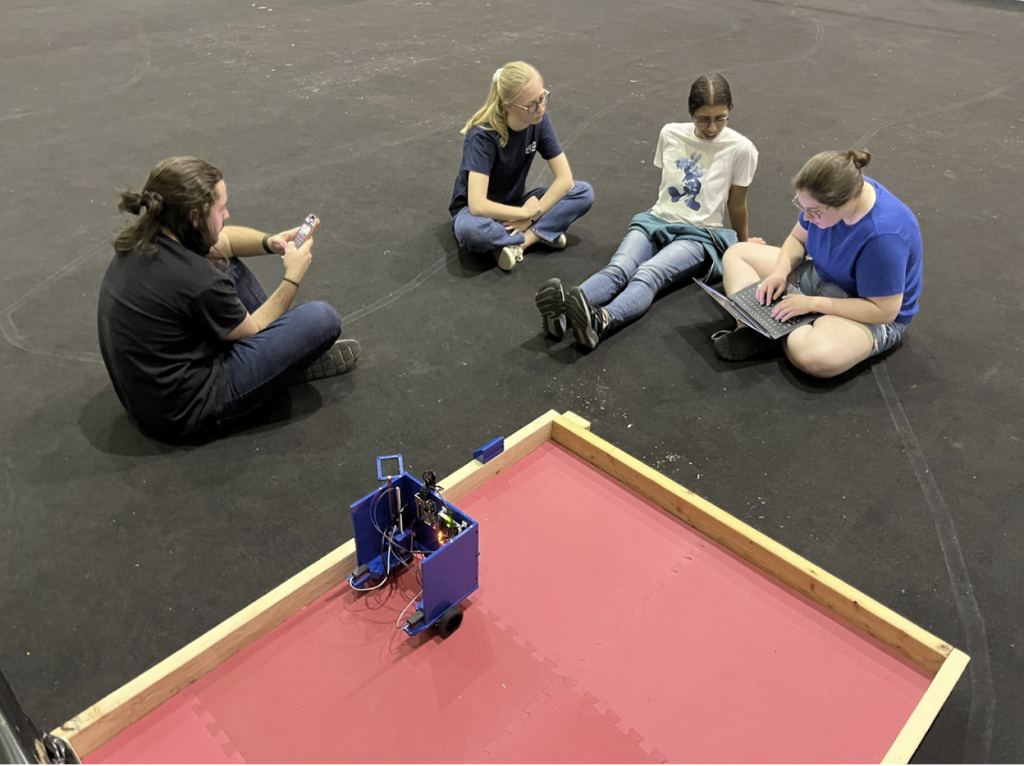
(From left to right) William Johns, Nadia Pavlov, Hannah D’Cruz, and Maura Toney troubleshooting in the robotics lab. Photo by Aiden Hoogstra
The club meets in the digital and microprocessors lab (Rayzor Hall 1040), twice a week: on Mondays at six p.m. and Fridays at five p.m. Right now, the club is divided into two teams working on their own projects, but Pavlov says that her vision for the club is even more small groups of students working on more diverse projects and learning from one another. One team is preparing for a competition through the Institute of Electronics and Electrical Engineers, wherein they must design a robot that can perform various objectives to compete with students from other schools doing the same. The other group is trying to get a Roomba to fly.
The IEEE competition is in Colorado at the IEEE conference from March 27 to March 29 and has recently been invited to a later competition in Saudi Arabia. This year’s IEEE challenge is called “Mining Mayhem” and is played on a four foot by eight foot arena like the one in the above image. Two types of plastic objects, identical in every dimension but for one’s being significantly heavier, are distributed randomly about the field, in and outside of the cave, and each team’s robot is given three minutes, with no signal sent to it from outside, to pick up and sort as many of the objects as possible.
In Saudi Arabia, the game will be capture the flag, but the plan is to use the same basic structure and program, named “turtlebot” for the way its components stack on each other, for both games. The team prepping for competition, headed by Pavlov, work in an abandoned pool and are currently in the process of getting their robot’s lidar scanner to render an accurate picture of the field in the Raspberry Pi (a small computer) that controls their robot.
The second group’s robot, named “RoombaRat,” is less of an ordered project. At the moment, they are trying to get a robot they have put into the housing of a Roomba to fly. The goal is ambitious, as its innards do not currently inhabit the Roomba housing, but team leader Kara Brown is optimistic about fixing that.
R.A.T.S. is looking for new members and offers plenty to learn for students in or outside of the STEM department. The president herself said, “I didn’t know how to do any of this stuff a year ago when I started the club,” but that with the help of Professor Friedel, the grad students who work with the club and some online resources, anyone can learn a useful amount about robotics.