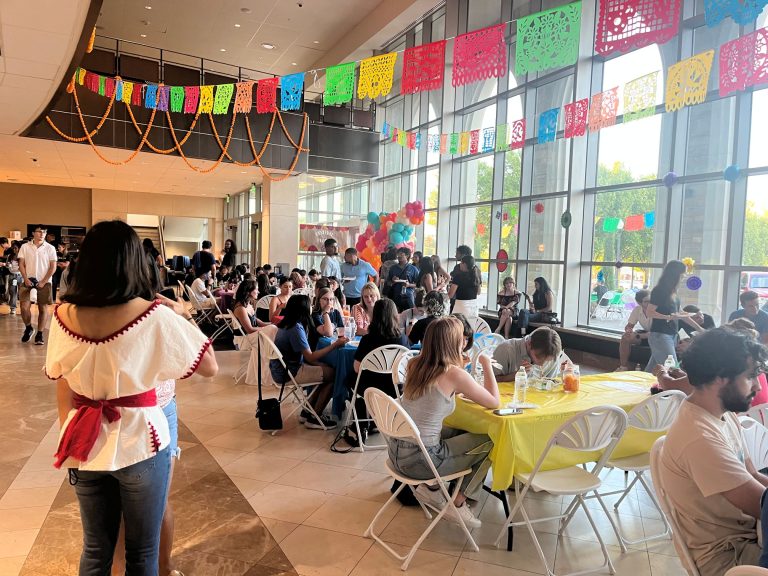



The Center for Heterodox Economics (CHE) at TU hosted its first conference this past weekend at 101 Archer.
The Center for Heterodox Economics held its inaugural conference this last weekend, kicking off Thursday evening with an introduction of CHE by The University of Tulsa President Brad Carson, Professor of Economics and CHE Director Dr. Clara E. Mattei, Chair of TU’s Economics Department Dr. Scott Carter, and Assistant Professor of Economics Dr. Bruno Theodosio. Each of the four discussed the importance of a center like CHE and the opportunity it provides for both academics and individuals in the community to integrate a diverse range of disciplines and methods to empower people to ask new questions and propose innovative solutions to socio-economic issues.
The particularly diverse nature of perspectives at the conference and its speakers was quite prevalent even from the opening night of the conference, demonstrated most poignantly by disagreements from speakers over the Political Economy of Occupied Palestine panel. Despite Carson’s initial praise of the center and particularly of the usefulness of heterodox economics during his speech, he also explicitly declared his “disappointment with the lack of diversity” specifically within Friday’s Political Economy of Occupied Palestine panel.

The group itself consisted of four highly qualified speakers including Raja Khalidi, an Oxford and University of London graduate who was the principal author of over 50 United Nations Trade and Development reports on the Palestinian economy, and Lamees Farraj, a researcher of fiscal and economic development policy, with a focus on socio-economic issues and political economy. It also included leader of the military embargo campaign from the BDS movement Shir Hever, and Assistant Professor of Economics at Trinity College and former researcher at the Palestine Economic Policy Research Institute, Ibrahim Shikaki.
Surrounding this topic, Carson’s comment specifically seemed to prompt strong opposition from other speakers at the conference. Dr. Carter, who spoke immediately after Carson, started by declaring, “The first principle of this conference is to recognize the genocide of our age” before subsequently welcoming everyone to the inaugural conference on behalf of the university’s economics department. Dr. Mattei later in the panel also responded to Carson’s criticism by discussing the prevalent censorship in mainstream academia surrounding Palestine, particularly how treatment of Palestinians under occupation is directly connected to the violence of capitalism and how critiques of this system are often written off by many university officials and academics as simply biased.

Thursday night’s discussion was then passed off to the first panelists of the conference, focusing predominantly on what heterodox economics means to the panelists and how they use it in their work, posing the question: “How does your work embody heterodoxy?” The first panelist, Anwar Shaikh, exile professor emeritus of economics at the New School for Social Research and associate editor of the Cambridge Journal of Economics, focused his discussion on the collective nature necessitated by heterodox economics. While Shaikh clarified that researchers in this field must agree to a general set of facts informed by empirical evidence, he also actively encouraged disagreement and arguments that arise from different approaches to these facts. Moreover, Shaikh emphasized how this process cannot be done alone and involves a collective consensus that can only arise out of argument because the task itself is long term and corrective.
The next panelist was James K. Galbraith, who currently holds a professorship in government at the University of Texas Austin and is the former executive director of US Congress’ Joint Economic Committee. Galbraith touched on numerous points that he discusses in his new book “Entropy Economics,” in which he makes connections between basic economic and scientific principles. He specifically talks on the mythic nature of a truly free market under capitalism. Drawing on scientific theories surrounding thermal equilibrium, Galbraith extends this understanding to the free market, positing that it inherently requires the regulation of inequalities to run smoothly or exist at all. Galbraith ends the discussion noting that nothing is eternal or imminent, including the current economic system of capitalism, denoting its fragile state and therefore the necessity of market regulation.
Ingrid Harvold Kvangraven, political economist and senior lecturer at King’s College, London, was the final panelist of the night, speaking much about her concentrations on unequal global development and decolonizing economics. Heavily influenced by Marxist economic thought, Kvangraven’s research concentrates on the way in which power relations determine economic outcomes and makes several suggestions as to what heterodox economics should address moving forward. First, she criticizes the anti-disciplinary split of politics and economics that began forming in the early 20th century, arguing that the political component is an integral aspect of heterodox economics. Additionally, related to her concentration on decolonizing economics, Kvangraven insisted that there must be more of a focus on global social relations situated within a context of international capitalism, and therefore an acknowledgment of systems of exploitation, imperialism, white supremacy, and misogyny. Only then does she believe that heterodox economics can continue moving towards theorizing in a non-eurocentric manner. Finally, Kvangraven digs into an issue that was previously brought up multiple times in the panel regarding the separation of academics from political action. She criticizes what she refers to as the “neoliberalization of universities,” and the subsequent removal of accountability and responsibility of academics to embody their theory both politically and in practice.
At the conclusion of the speakers’ introductions, those at the conference could engage with the panelists and speakers, allowing community members to get involved in the discussion. Many of the questions from the audience reflected their larger concerns about the ways in which CHE intends to extend its reach to include all different individuals in discussion, particularly those in rural areas or with drastically differing viewpoints. Director of the center Dr. Mattei validated these concerns, emphasizing the importance of including these individuals in conversations and also of using knowledge as a tool of liberation for the oppressed. Discussion during the panel then drifted to the inherent compatibility of reason and justice, reflecting a belief that a commitment to reason is no different than a commitment to justice and therefore the oppressed. The night ended discussing the topic of the next evening’s panel about community organizing and class consciousness, with a focus on the role organizers on the ground play in getting a seat at the table.