


Due to pressure from animal rights groups, the student body president will be chosen via election this year.
Since the position’s conception, the student body president at the University of Tulsa has always been selected the same way — until now. On Thursday, Feb. 12, it was officially announced that the annual sheep-throwing competition that the Student Government Association uses to select the president has been indefinitely cancelled and replaced with a student election.
The sheep throwing competition, of which TU students and staff alike have bemoaned the loss, traces its roots back to the university’s conception as the Presbyterian School for Indian Girls in 1882. As a part of its alignment with Presbyterianism and the Scottish reformation, educators attempted to instill some Celtic culture by holding a traditional sheep-hurling, which, there is incidentally no record of ever having occurred.
Regardless of its mistaken historical significance, the competition quickly caught on as an anticipated tradition and was embraced by new faculty when the school expanded into the Henry Kendall College in 1894, with the winner of the contest being first given the then-joking title of “President of the School.” Since then, the student body president and later SGA evolved out of this position, and every year hence, students have crowded on Dietler Commons ready to watch the candidates take their three attempts to huck a live sheep as far as possible.
This time-hallowed method of selecting the student body president has produced legends in Tulsa. Few TU alumni could not recount the performance of Barney “Barn-Door” Shuckems of 1968, who killed the sheep on all three of his throws for the first time in TU history while still losing the distance competition for having thrown them straight upwards. He was awarded the vice presidency for his achievement, leading to the creation of the position. Also legendary was the punting ban of ‘05, which ended the seven-year streak of soccer player presidents, and the sheep scandal of ‘97 when a student won by using a cloned sheep missing half of its bones. Indeed, this tradition was a beloved and mighty one at our institution.
Fast forward to last Thursday, and it all came crashing down. In a joint email from the University of Tulsa Student Government Association and the Board of Trustees, it was announced that, “Due to concerns about animal cruelty and the sanctity of the democratic process, the 2026 SGA president will be chosen via democratic election.” The email continued to decry sheep throwing as “unnecessary” and describe the electoral process as “a marked improvement from years past,” making it abundantly clear that sheep throwing would not make a return in the future.
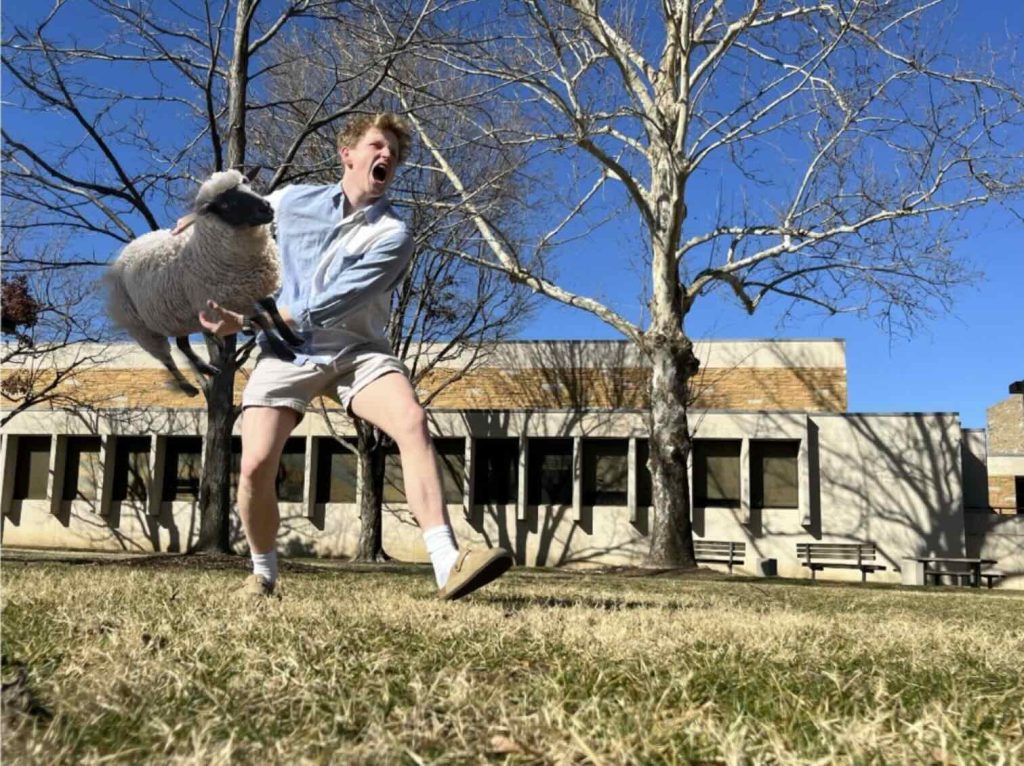
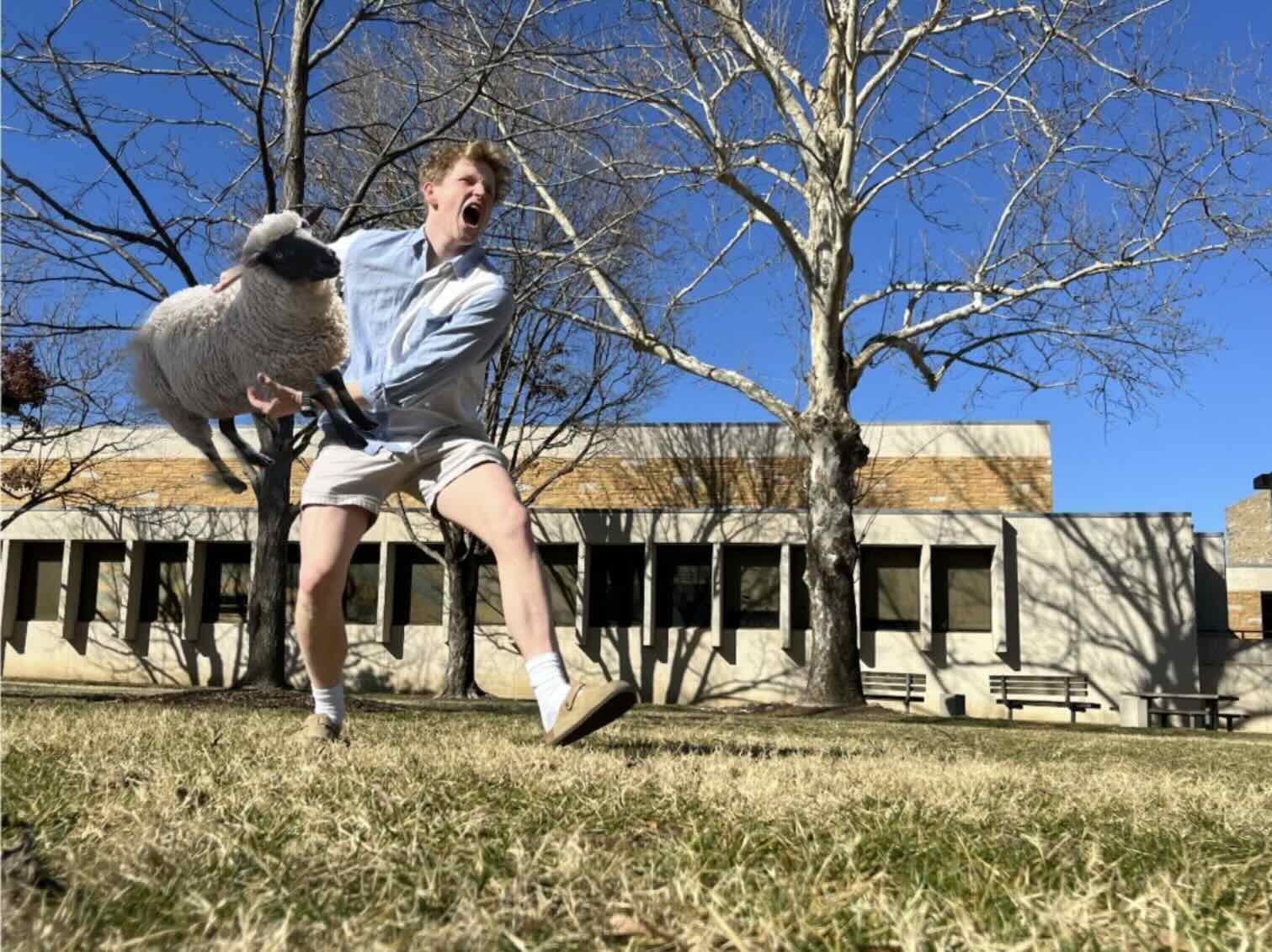
Presidential candidate Bruce Bigler, intensely practicing before Thursday’s devastating announcement. Graphic by Aiden Hoogstra
Many have protested the change, with several candidates joining in a massive protest demanding that “Student voices be herd.” Many at the protest blamed animal rights groups, such as the People for Ethical Treatment of Animals, whose logo was borne on several angrily burned flags.
“PETA’s always been stupid, but it’s just crazy if they think they’re helping these sheep,” commented junior Lee Olivio. “You know where we got them from? The slaughterhouse, literally in line to be killed, and we even set the ones that live free.” In part, Olivio was right: the sheep’s survival rate of 60% is significantly better than the effective zero they enjoy at the processing facility. When it comes to PETA, though, there has been no official mention, although several students outside of the protest agreed that they were to blame. Senior Jesús Fernandez said, “I knew this was coming — most people did. The animal rights guys have been breathing down admin’s necks for years. It just sucks for the freshmen who never got to experience it.”
Staff have also expressed concerns. Political Science professor Shawna Greene has cautioned that the new method of election is unwise. “College students especially, but really all voters, consistently prove themselves incapable of selecting apt leaders,” she explained. “The sheep throwing competition’s training demands and public display meant that only the strongest, most dedicated, and most socially adapted could become president. Now, it’s just a popularity contest.”
Other department members echoed Greene’s concerns, but more prevalent was apprehension over the Board of Trustees’ silence on the selection method for the University President, and what that might mean for future hires. At press time, no comment has been made on whether Brad Carson’s successor will still be chosen in the traditional horse juggling arena.