



Undergrad and law students get the opportunity to ask Justice a variety of questions.
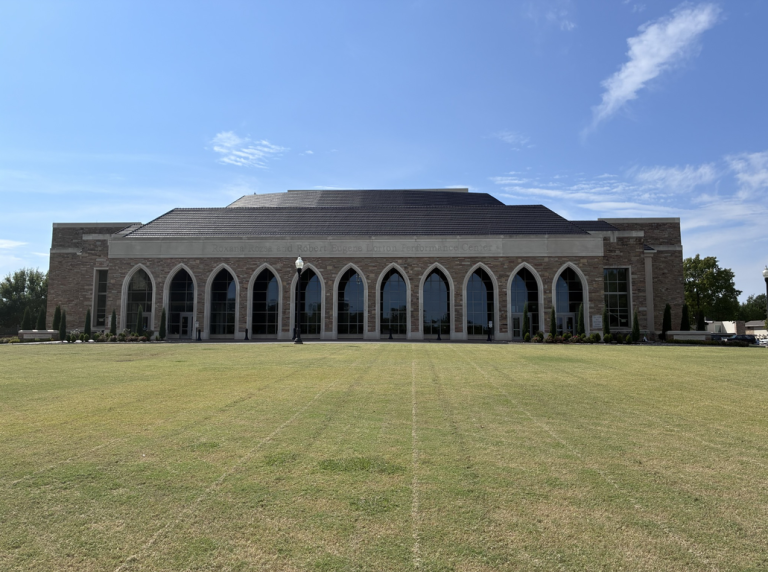
This Wednesday, Sept. 16, Supreme Court Justice Sonia Sotomayor was in Tulsa for a few hours in a closed door question and answer session with students and faculty. The event was hosted by the University of Tulsa College of Law in collaboration with the Northern/Eastern Oklahoma Chapter of the Federal Bar Association. It took place in the Lorton Performance Center and was invitation-only, requiring all participants to sign up several weeks in advance so they could pass background checks and other security measures. Law students from both the University of Tulsa and several other Oklahoman universities were invited, in addition to select groups of TU undergraduate students such as members of the Pre-Law Society and the Honors College.
Sotomayor had time to answer 10 pre-screened questions submitted by University of Tulsa law students in preparation for the visit. The first question asked how Justice Sotomayor practices judicial responsibility, and distinguishes between the law as it is and her own personal experiences when deciding cases. Her response was that it really is less difficult than one would think. She stated that only God can make purely moral decisions, and since judges and justices are certainly not God, they must base their judgments on the law alone. There is always a loser in every single court case, so it is the responsibility of every agent of the law to make sure that the person who lost knows they did so for impartial and non-arbitrary reasons like a single person’s system of morality. Sotomayor did make the disclaimer that sometimes personal bias does slip through the cracks, citing her time as a judge in New York when she realized she had been giving a certain man leniency in sentencing because he reminded her of her grandfather.
Another student asked Sotomayor what legal theory she uses to interpret the Constitution. She responded by saying that, while some of her colleagues practice constitutional originalism, “I don’t find myself so limited,” and made clear her disdain for the idea that the Constitution should be interpreted as the “founding fathers had intended.” Instead, when constitutional intent is not clear, she relies on a historical development of the law or topic, both generally and in the legislature specifically, to illuminate the meaning of a statute.
Two students asked Sotomayor to describe the methods she found most effective when persuading the other justices on the court, and how she managed to keep the peace in such a tense environment filled with disagreement. She responded that you cannot persuade someone without understanding their motivations and fears and working to assuage those fears. She works to compromise and find a solution that may not be exactly what she is looking for, but is better than the alternative, while also acknowledging that sometimes compromise is impossible because the two parties want fundamentally opposite outcomes. In order to keep the peace with people she disagrees so heavily with, she answered, “I religiously look for the good in people, especially in my colleagues.” Getting to know and befriending her colleagues makes it easier for Sotomayor to get along with them even in spite of their disagreements. She mentioned Justice Clarence Thomas and how frequently and vehemently they disagree on legal issues, but how she is able to get along with him because he knows every single worker in the Supreme Court by name and makes an active effort to stay up–to-date in their lives.
Lorton Performance Center, where photos were banned during Sotomayor’s visit. Aiden Hoogstra | Collegian
There were also a number of personal questions. The second questioner asked Sotomayor about values she learned as a child that guided her through her judicial career. She answered that because of the generation she grew up in, she was taught to always respect everyone, especially her elders. She spoke about how treating everyone with dignity has served her very well and gave an anecdote about how after sentencing one man, he asked to speak and thanked her for looking at him while she sentenced him, because a judge had never done that for him before.
The amount of personal questions was somewhat frustrating for some, given the marked absence of questions focused on specific modern law and legal doctrine. This likely has to do with the process for selecting questions. Third-year law student Renner Howell remarked that the process for submitting questions was very exclusive. Only a limited number of law students were invited to submit questions, and from there, law school faculty read through them and submitted 10 questions to Sotomayor’s staff, who also had the chance to vet them. Students were also instructed to read their questions to Sotomayor exactly as they had been approved when they were written. Because of this, professor of political science Dr. Sahar Abi-Hassan stated that, “One thing I would’ve liked to see more on was judicial substance. Framing objectivity as a matter of disposition and humility sends a good signal, but it says nothing about whether such neutrality is achievable at all, given how consistently ideological blocs on the Court divide on high profile cases.”
However, despite the relative strictness of the framing of the questions, Howell, Abi-Hassan and others had many positive things to say about the event. Senior political science major Alea Vacarella exclaimed that, “This has been the best day of my professional career!” Abi-Hassan appreciated the “rare, candid look into the human side of a justice” and Sotomayor’s comments about both media literacy and how she manages to get along with her colleagues. Howell also greatly enjoyed Sotomayor’s insights into her professionalism, as well as her personal insights in general. He said, “I thought it was an absolutely wonderful opportunity to get to see one of the top legal minds share not only her approach to legal interpretation, but also a little of her history that made her into the person she is today. I’m very grateful for the hard work of our administration, student leaders and everyone else who made this event possible.” Howell shares this in common with many other students and faculty who thoroughly enjoyed the opportunity to hear one of the nation’s most influential legal minds speak, even if in a limited manner.