Election-night broadcast follows results from Oklahoma City to Tulsa, with additional coverage of Texas and Kansas.
TUTV provided live coverage of the 2026 midterm elections Tuesday night, Nov. 3, tracking results across Oklahoma and neighboring states as voters determined the direction of several closely watched races. The broadcast, co-anchored by senior Bruce Bigler, junior Jake Borsuk, junior Luke Montemayor and sophomore Reese Wood, featured in-studio analysis, live election-night coverage from candidates’ watch parties and discussion of the political developments shaping results in Oklahoma, Texas and Kansas. While Oklahoma Republicans retained their hold on all statewide offices, Texas and Kansas saw significant Democratic victories.
The broadcast began as an overview of the races on Oklahoma’s ballot, including the gubernatorial, Attorney General and U.S. Senate contests. Wood and co-anchor Borsuk also noted that the University of Tulsa’s Lorton Performance Center served as a polling location for students living on campus and in the surrounding area.
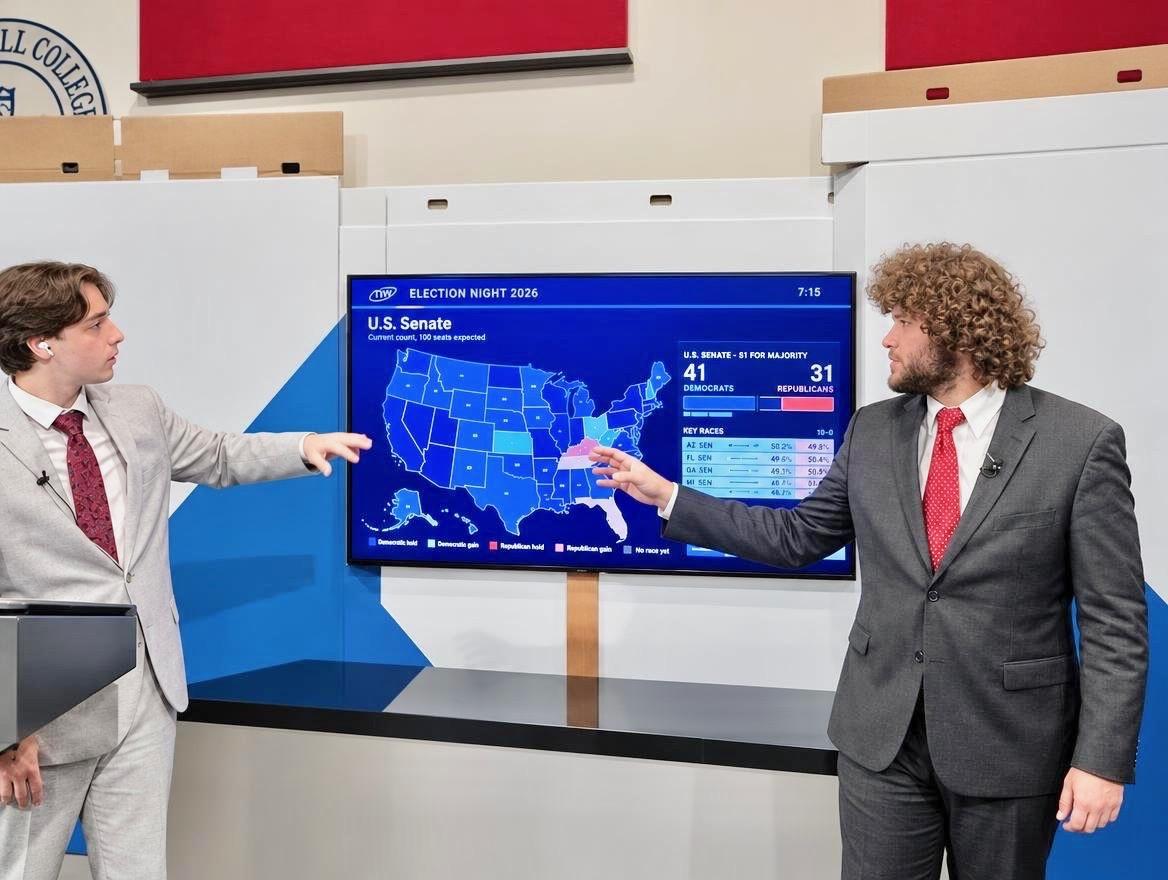
After Wood opened the official broadcast from the studio desk, juniors Aristotle Orsini and Anderson Bell began following incoming results from a map displaying election returns. The station also dispatched reporters to two prominent Oklahoma election-night gatherings. Junior Alexander Raza reported from Republican gubernatorial candidate Mike Mazzei’s watch party in Tulsa, while senior Carter Reed covered Democratic candidate Cyndi Munson’s gathering in Oklahoma City. In addition, Riley Wilson was live from congressional candidate John Croisant’s watch party in Tulsa.
Ahead of Election Day, TUTV also provided profiles of gubernatorial candidates and their campaign priorities. The coverage highlighted Mazzei’s proposal to eliminate property taxes and promote economic growth, while Munson emphasized education, affordable housing and access to healthcare. The candidates also presented differing approaches to the state’s economic and social priorities as they competed to succeed term-limited Governor Kevin Stitt.
The Oklahoma gubernatorial race was among the central focuses of the evening. Mazzei ultimately prevailed with 51.93% of the vote to Munson’s 45.92%. Although Republicans retained control of the governor’s mansion, the contest was considerably closer than the double-digit margins in Stitt’s two prior victories. According to KOSU, Mazzei’s six-point margin was approximately half the margin Stitt secured in both 2018 and 2022.
Early returns initially suggested a potentially different outcome. During the broadcast, Bell and Orsini noted that Munson had taken a lead of roughly 15 percentage points when only 10% of the vote had been counted. They cautioned, however, that such results were preliminary and that additional ballots could substantially change the standings.
Bell, one of the reporters providing in-studio analysis, said the competitiveness of the race was unexpected given Oklahoma’s recent voting history. He noted that President Donald Trump carried the state by 34.26 points in 2024, adding that pollsters and political analysts had not anticipated a close gubernatorial contest, even in the weeks leading up to the election. “People did not expect this race to be competitive a few months ago,” Bell said on air. “They didn’t expect it to be competitive really a few weeks ago.”
The gubernatorial contest was not the only Oklahoma race that drew attention from the in-studio commentators. As early congressional returns came in, Bell and Orsini also discussed unexpectedly strong initial performances by Democratic challengers John Croisant and Jena Nelson in Oklahoma’s 1st and 5th Districts respectively. With only a portion of the vote counted, both candidates held early leads over their Republican opponents, although the commentators emphasized that the results remained preliminary.
In Oklahoma’s 1st District, which is centered around Tulsa County, Republican Mark Tedford defeated Croisant by a 4.64% margin. This seat was open because of Representative Kevin Hern, who won reelection for the U.S. Senate seat in 2022 by 26.5%. In Oklahoma’s 5th District, which encompasses the northern half of Oklahoma County along with the eastern suburbs of Oklahoma City, incumbent Representative Stephanie Bice won reelection by a 1.27% plurality against Nelson. This was a significant underperformance from 2022, when she was reelected by a decisive 21.6% margin.
TUTV also examined the issues shaping the congressional contests. In its profile of the 1st District race, the station highlighted disagreements between Tedford and Croisant over the expansion of artificial intelligence data centers. Tedford supported their construction, claiming they were necessary for American competition with China, whereas Croisant called for stronger regulations addressing their impact on energy use, water resources and surrounding communities.
TUTV’s election coverage also reported on the results in Texas and Kansas, two states with substantial connections to the university’s student population. Both states produced notable Democratic victories in their U.S. Senate and statewide races.
Before Election Day, TUTV profiled the Texas Senate candidates, highlighting differences in their campaigns. The coverage described Democrat James Talarico’s emphasis on economic populism and health care reform, while Republican Attorney General Ken Paxton focused on his support of Trump and the administration’s immigration policies. The station also noted that the two candidates had not met on a debate stage despite multiple offers from Talarico.
Talarico defeated incumbent Paxton by a decisive 12 point margin, while Democrat Gina Hinojosa defeated incumbent Republican Governor Greg Abbott by seven points in Abbott’s bid for a fourth term. Democrats also captured all other statewide executive offices and control of the Texas House of Representatives, marking a dramatic shift from the state’s traditional Republican dominance. Talarico’s victory made him the first Democrat elected to the U.S. Senate from Texas since 1988, while no Democrat had won statewide since 1994.
During their discussion of the Texas Senate race, Bell and Orsini also examined county-level results to illustrate the scale of Talarico’s performance. In Harris County, home to Houston, Talarico was leading Paxton by roughly 34 percentage points, while his margins were even higher in Bexar and El Paso counties. The commentators pointed to these results as evidence of Talarico’s strength in the state’s major population centers.
Kansas also produced notable results. Democrat Adam Hamilton defeated incumbent Republican Senator Roger Marshall, while Democrats held on to the Governor’s mansion and flipped the attorney general’s office. Hamilton, senior pastor of the largest United Methodist congregation in the nation, became the first Democrat elected to represent Kansas in the U.S. Senate since 1932.
The Kansas Senate race received considerable attention from the commentators as returns came in. During an early update, they noted that Hamilton held an approximate 25 point lead over Marshall, an especially striking development given the electoral history of Kansas. The commentators also discussed a similarly strong early Democratic performance in the state’s gubernatorial race.
Bell attributed the Democratic victories in both states to several overlapping factors. He pointed to both Talarico and Hamilton’s efforts to appeal to religious voters, arguing they successfully fought to reclaim religious identity from the political right. He also identified federal policies, namely the Liberation Day tariffs and the Iran War as potential factors, suggesting that high prices resulting from the White House’s policies may have discouraged some Republicans from voting or encouraged others to vote for Democratic candidates.
Earlier in the broadcast, Bell and Orsini discussed how national political issues appeared to be influencing voter participation in state and local contests. They observed that voters were increasingly focused on national-level representation, including House and Senate races, rather than limiting their attention to candidates and issues within their own states.
As the votes came in, Bell and Orsini connected the results in Texas and Kansas to broader national political trends. Discussing the U.S. Senate race in Texas, Bell pointed to the impact of “the Trump endorsement in the primaries,” arguing that some Republican candidates who appealed to the party’s base struggled to attract support from the broader electorate.
Beyond the individual state races, Bell and Orsini also examined the broader national shift in voting patterns. Using a map comparing results with the 2024 presidential election, Orsini noted that every Oklahoma county had shifted toward Democrats, despite the state remaining under Republican control. Orsini described the trend as part of a broader movement toward the Democratic party, saying the results across the nation had “swung hard for Democrats.”
Bell and Orsini also connected the results to the historical tendency for the president’s party to lose seats during midterm elections. They noted that this pattern had appeared in most midterm elections since World War II, placing the Democratic gains in Texas, Kansas and other states within a broader national left-leaning trend.
Wood described the livestream as an important step forward for the station. He praised the work of the in-studio analysts and said he hoped TUTV would continue expanding its election coverage. “Despite some technical setbacks due to trying out some tech that’s new to TUTV, the election livestream was a big success in every way,” Wood said. “It was a lot of fun to get to anchor for something that was constantly changing in the moment, and our two analysts, Aristotle Orsini and Anderson Bell, were able to bounce back and forth with entertaining and insightful commentary all night. This was a big step forward for TUTV, and I hope we continue to expand.”