

RFK Jr. decimates the bagel supply at the University of Tulsa.
Last week, it was reported that all of the University of Tulsa’s Einstein Bros. poppy seed bagels had disappeared. Additionally, Einstein’s staff, when questioned, could not provide a reason why the starchy toruses were out of stock. Plagued by the uncertainty of ever enjoying the beloved bagel variety again, panic ensued among the student body.
However, a leaked memo from the Food and Drug Administration (FDA) has finally shed light on the crisis. According to the document, Health Czar Robert F. Kennedy Jr. personally flagged the University of Tulsa’s Einstein Bros. location after an anonymous tip suggested the poppy seeds were part of an “Iranian neurological infiltration conspiracy.” Effective immediately, the FDA has classified the campus poppy seed supply as a Level One Biohazard. Federal agents secretly raided Einstein’s kitchen in the dead of night, sealing the breakfast pastries in yellow hazmat barrels before transporting them to an undisclosed facility for “molecular de-vaccination.”
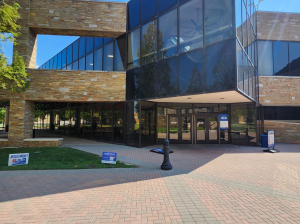
The raid, which involved heavily armed Department of Health and Human Services personnel wearing tactical aprons, also resulted in the temporary seizure of the toaster, which federal investigators suspected of being a launchpad for rogue seeds. A secondary perimeter was established around the perimeter of the Union, with armed guards meticulously cross-examining anyone attempting to enter the building. By sunrise, a solitary sterile sign stood in place of the once vibrant Einstein Bros. location, reading, “Cease and Desist All Yeast-Based Infiltration.”
The campus reaction has been a mix of profound despair and extreme confusion. “I just wanted my morning farmhouse bagel,” said a junior who would only be identified as the “Bagel Martyr” while staring at the empty display case in the Student Union. “Now the government is telling me my morning breakfast was a foreign bioweapon. I’ve eaten five of those a week since freshman year. Am I a sleeper agent now? Is that why I’m two weeks away from developing a nuclear weapon?” Immediately afterwards, he ran off screaming in frustration at how his diet had been vastly upset by this recall.
Academic departments instantaneously fractured over how to handle the sudden geopolitical significance of breakfast. The Department of Political Science immediately hosted an emergency panel titled From Everything to Nothing: The Geopolitics of the Breakfast Pastry, during which professors debated whether a poppy seed constitutes a weapon of mass destruction. Meanwhile, the chemistry department began offering underground purity testing, allowing panicked undergraduates to bring in suspicious crumbs from everything bagels to verify that their morning routines had not been compromised by international espionage.
Other students expressed entirely different grievances, all devoid of concern for public health. A senior by the name of Chicken voiced intense rage over the lack of aesthetic synergy on campus. “The poppy seed bagel provided a great visual contrast to the otherwise monotonous blah of the cream cheese spread,” Ms. Chicken asserted aggressively while pointing at a plain bagel. “Without any black speckles, the entire integrity of my Instagram stories has been compromised. If RFK Jr. wanted to protect us, he would have banned decaf coffee, which is a crime against humanity.” Chicken had no comment on the actual chemical composition of poppy seeds, but clarified that she “distrusts all seeds that do not require any permit to harvest.”
While the visual aesthetics of breakfast dominated the humanities, the university’s wellness coordinators saw the biohazard classification as a paradigm-shifting opportunity for market realignment. An internal memo circulating through administrative offices suggested that the poppy seed vacuum left an ideal opening to test student compliance ahead of the upcoming spring semester. Rumors briefly spread that the university was considering replacing the entire franchise with a zero-calorie air-vending concept, but immediate pushback from student athletes forced campus dining to lean into a more aggressively terrestrial narrative.
The escalating crisis took a bizarre turn on Thursday morning when the University of Tulsa, through its official accounts on social media, announced the implementation of the “Healthy Campus, Pure Mind” initiative. To fill the culinary void left by the ban, 1894 Dining Services announced they would replace all missing poppy seed bagels with “organic, unsupplemented wheatgrass bricks” from Harwell field. According to a university spokesperson, the bricks will represent a “natural dirt flavor” designed to detoxify students ahead of midterms.
The initial rollout of the wheatgrass bricks on Friday went about as smoothly as a blender full of actual sod. Long lines of bewildered students queued at the dining counter, only to receive a damp rectangular mass that resembled a freshly harvested square of turf from a miniature golf course. Several freshmen attempted to run the bricks through an industrial toaster, resulting in thick grassy smoke triggering the fire alarm. The Student Union was evacuated, and according to one witness, smelled “exactly like a burning lawnmower.”
Despite mass demonstrations by the newly formed Student Poppy Seed Liberation Front, campus administration is fully cooperating with the FDA ban. When reached for comment, a university spokesperson expressed absolute confidence in the transition. “We understand the student body is upset, but this is for their own biological purity,” the spokesperson declared via a pre-recorded voice memo. “If they truly crave circular bread items with little black dots on them, they should draw them on the bagel with a sharpie.” When asked if sharpie ink was FDA-approved, the representative immediately terminated the call. At press time, The Collegian was able to confirm that the university’s fraternities and sororities have already begun smuggling contraband poppy seeds from Afghanistan onto campus hidden inside of hollowed-out hydroflasks.