
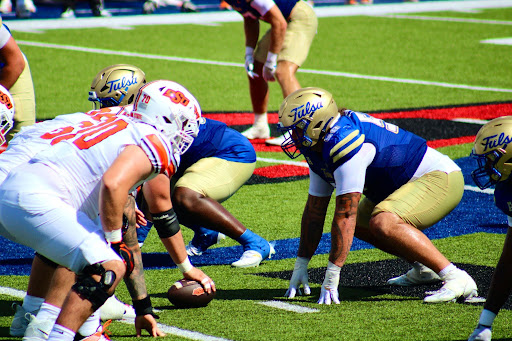
Making sense of the hurricane of new eligibility rules and their implications for Tulsa fans and athletes.
This past weekend marked the first week of the college football season, but it was the courtroom, not the football, which dominated the headlines. The top story in college athletics throughout the week has been the attempt by many different schools, but most prominently by Louisiana State head coach Lane Kiffin and his program, to sign last second additions to their rosters straight off of the National Football League practice squads. This wave of professional athletes returning to college kicked off a storm of outrage across the college sports world, culminating in a lawsuit filed by the Southeastern Conference against one of its own members in LSU, and a vote on Thursday to decide whether they would be expelled from the SEC. Kiffin ultimately opted to back off of the ledge and refrain from rostering ex-NFL players Zxavian Harris and Dae’Quan Wright, former players of his at the University of Mississippi, to his LSU roster, but there remain similar cases across college sports which have yet to be resolved.
Casual fans probably have many questions about this developing situation and how it affects the University of Tulsa, so a summary of what has occurred over the last eight months in college athletics is in order. Early in the spring, the National Collegiate Athletic Association (NCAA) announced that a new eligibility rule would go into effect for athletes who graduated high school in 2023 or later. This rule states that college athletes now have five years of eligibility, rather than the four they were previously allowed. This is a significant change because under the old system, while players were only nominally given four years, they were allowed a “redshirt” year, where they could sit out while still being on their team, and retain their four years to play. Athletes were also granted extra years of eligibility for a range of other reasons, mostly related to medical situations, but the bottom line is that a few athletes were playing for seven or eight years in college sports, while others were still only allowed four. The new rule strips away most of those exemptions as well as the redshirt rule; athletes now have five years to play five years.
What turned this new rule, considered by most to be common sense, upside down is the fact that it excludes the high school class of 2022. A wave of players in the outgoing senior class across a number of sports have filed lawsuits because of their exclusion, asking to be granted a fifth year with the rest of the current NCAA athletes. In many cases, district judges have granted a temporary restraining order (TRO), essentially stopping the NCAA from enforcing their rules, clearing the path for these athletes to return to college for another year. Some of the players involved, such as the LSU pair, had already joined professional teams, and it is this that has generated most of the hubbub over the last few weeks, as desperate football coaches looked to make late additions to their rosters. Conferences have stepped into the enforcement vacuum, however, to stop the return of professional athletes to college, as demonstrated by the SEC this week. The upshot of it all is that a number of class of 2022 athletes across various sports remain in limbo, unsure if they will be able to play in college this academic year or not, and coaches in turn are unsure if they will be able to mine what would be a valuable pool of experienced athletes to fill holes on their rosters.
In terms of the University of Tulsa, the legal chaos stands to have at least a moderate impact on athletic programs. On Sept. 3, a Tulsa County district judge ruled in favor of six athletes from TU who graduated this past spring and decided to challenge the new NCAA rule. The athletes claimed that “The NCAA’s new rules excluded the class of 2022 without any cause or
reasonable basis, and these class of 2022 athletes were left with no choice but to take their case to the courts.” This comes by way of a press release disseminated last week by Brewster & De Angelis, P.L.L.C, the legal firm responsible for representing the athletes in their lawsuit against the NCAA. The six players, unnamed in the memo, “include members of the soccer, volleyball, golf, softball and football teams. These six young women and men not only have the chance to compete this year but, just as important, also look forward to using their athletic scholarships to complete their studies in business, sports and exercise science, nursing and speech and language pathology.”
While the impact of adding one or two returning players to the football team, for instance, might not seem consequential on its face, the margins are thin in college athletics, and one or two plays can change the outcome of a game and season. These additions are significant, especially for programs such as the TU women’s golf team, which sends just five athletes to most competitions, or the volleyball team, which only rosters 12-14 players any given year.
With all the upheaval surrounding eligibility in college athletics right now, the only certainty is that the ability of the NCAA to enforce its rules is being undermined in a way that will not easily be undone, raising the question of whether it will even continue to exist, and if not, who will enforce the rules. In the face of this uncertainty there is little that fans of the University of Tulsa can do except enjoy the sports being played on the field, and the success TU is having so far during the fall season. Regardless of how judges, lawyers or any of the high level mustaches try to involve themselves, there will be football played in H.A. Chapman Stadium this fall, and Tulsa Volleyball will take the court in the Reynolds Center, which means college sports, at least here in Tulsa, will be just fine.