80% reduction in funds leaves salary, print in flux after over 100 years presence on campus.
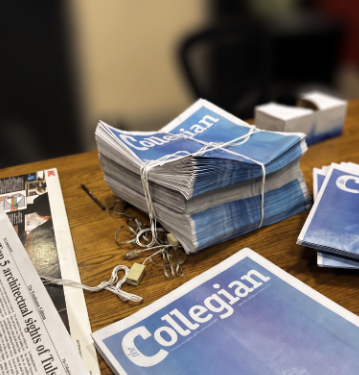
The Collegian, as well as other University of Tulsa student-run media outlets like TUTV Media Lab, have experienced major formative budget cuts in the last academic year. For The Collegian, the impact is devastating. A lack of funding from the university has inhibited its ability to publish print editions or pay staff members the already modest salaries they had been promised. Funds have been cut close to 80% in the span of just two years, resulting in a complete halt on printing for the entire 2025-2026 school year.
Pressure is mounting for the paper to produce the same quality and consistency in reporting, but without sufficient funding to pay for writing, its ability to attract new qualified student reporters is in jeopardy. The situation at The Collegian ultimately reflects budget cuts felt in broader news outlets. The Reuters Institute reported that in 2025, over half of global news audiences obtained information through social media platforms instead of reputable news outlets, and in the United States, only a quarter of people say they trust the news. As the possibilities for the ways people consume news continues to expand, demand for traditional journalism declines, reducing the funding and resources available to any news outlet.
At the beginning of the year, Managing and Copy Editor Ally Jones was told that The Collegian had no dedicated funding source, and that its finances were severely limited. To offset the issue, Dean of the Kendall College of Arts and Sciences, Dr. Blaine Greteman, encouraged an increasingly online-focused model for the publication, arguing that students should practice “communicating in the modes in which [they] are most familiar. [They] should be thinking about how to engage in the spaces that really are dominant now. ” Greteman said that even Yik Yak should be considered a viable option to distribute real news, as students commonly turn to it for information.
However, for many, a physical paper offers a different kind of presence than an article appearing in a social media feed or on a website. A print edition is easily accessible, as it is distributed through every major building on campus. In a recent survey, approximately 75% of respondents said they preferred and were more likely to read The Collegian in print. The paper’s Editor-in-Chief, Aiden Hoogstra, says he has received myriad requests from complete strangers through email, Instagram direct messages and even in person to print the paper again, and
Jones agrees. “I’ve always preferred print, personally. My freshman year, before I even worked for the paper, I would always read one of the copies left in Hardesty between my classes. It has more of a charm to it and it’s just more accessible to the student body than a website is. … The amount of pride you feel when you can hold something you helped create in your hands is unmatched.”
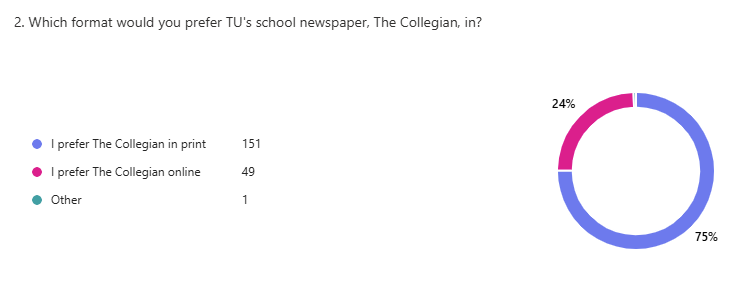
A poll currently at 200 responses favors print over digital Aiden Hoogstra | Collegian
The question of print is closely tied to a dispute over what financial resources are actually available to The Collegian’s staff. Jones described contact with administration to be “frustrating” at times.
In August, The Collegian was preparing a print version of its Freshman Edition — quoted at approximately $320 for printing. Later discussions introduced a different figure: $500 per issue. Through email, university leadership explained that the higher figure accounted for “indirect costs,” including faculty time and other institutional resources involved in supporting the publication. With the budget already stretched thin, writers will not be compensated unless more revenue can be generated through advertisements or donors.
Hoogstra explained, “I have spent at least 24 cumulative hours just trying to sell ads to people, and I know [Jones] has put in a similar amount of effort. I spent a full Saturday just riding my bike up and down Cherry Street, 11th, the strip mall on Yale and some other spots collecting business cards and talking to business owners, then spent the rest of the evening emailing people and coordinating with our website guys and admin to get the ads. I’ve sold a little under $1,000, but the way our budget is set up is really convoluted; we have the money we need, but our account won’t let me access it.” Hoogstra is currently working with administration to find a workaround, but difficulties remain: “It’s a circular problem. I’ve got enough people who have agreed to advertise once we do print that it would pay for our printing, but administration won’t let us print – ” and therefore earn that money – “until they see that the money is already in their account.”
Greteman argues that if writers were paid, there would be “a little bit of an inequity … because TUTV has never paid their writers.” According to Greteman, who wrote for his own college newspaper and later TIME magazine, “A better model to get involved in journalism, the same way people like me do, because you love doing it, and because you want to communicate with an audience. ”
Jones raised another point: “Working for The Collegian is a part time job. I mean, to make the freshman edition the section editors worked in Kendall for over 11 hours on a Sunday. I worked for over 12. That doesn’t even include the time we took at home to write and proof articles. Even before we took even bigger pay cuts, that’s well under minimum wage. It’s very hard to ask people to put in this kind of effort for little to no pay.” Hoogstra agreed with her. “I’ve been working [for The Collegian] probably six or more hours every day, eight on weekends.” he said. “I can afford to do things like that, but… for a lot of students, that bit of grocery money we said we could pay them is needed for them to spend this much time working for the paper and not getting a different job.”
The Collegian’s current goal is to print once every other week, and following pay cuts to editors and the removal of the writing compensation, Hoogstra and Jones claim that they have enough money to do so. “Right now it’s just about proving that the students really do want the print version,” concluded Hoogstra. You can fill out the print survey here.